Category: Civic Issue

Drug trafficking

In my past civic issue blogs, I have been writing about human trafficking. For this one, I want to switch it up a bit. We will be talking about the world of drug trafficking and how it is affecting the nation. Drug trafficking is a federal crime, the “selling, transporting or importing illegal drugs.” It involves growers, producers, couriers, suppliers, and dealers. Drug trafficking is also called drug distribution, it is important to note that it is not the same a drug possession. There are three different categories of illicit drugs the ones that are produced from a natural plant, those that are synthetically produced, and psychoactive pharmaceutical drugs that are used for the wrong purposes. 

Drug trafficking is a very lucrative industry for organized crime groups. It is also heavily associated with other types of crime like human and arms trafficking. As these crimes are all so closely connected by impacting the drug trafficking industry in simultaneously impacts the others. This is one of the reasons why it is important to try and cut down on drug trafficking. 

Drug trafficking affects almost every aspect of our lives. It affects the economy, justice system, health care system, and even environmental destruction. Not only that but its largest victims are the users and addicts.

Drug trafficking is in direct correlation with illicit drug use and abuse. These practices have a large effect on the economy “The economic cost of drug abuse in the United States was estimated at $193 billion in 2007”. The cost mainly comes from the loss of productivity due to things like participation in treatments, jail time, and death. Other parts of the cost come from health care and criminal justice costs. In 2020 the government requested a budget of $35.1 billion for National Drug Control. This money would go to preventing drug use and raise the consequences that come with it. Morally and culturally the prohibition of drugs makes sense, however, from an economic standpoint it seems like a lost cause. There is evidence that shows that the more effort that goes in to stop the illegal drug trade benefits the producers. This is because of the still high demand but low resources causing a large increase in price. 

The impact that drug trafficking has on the criminal justice system is it taxes resources at each stage of the process due to how widespread it is. To try and alleviate the burden that this has caused on the criminal justice system drug courts and other diversion programs have been developed. Many of these programs work on the rehabilitation of the offender to try to lessen repeat offenses. 

The environmental impact of drug trafficking has much to do with the cultivation and production of illicit drugs. Drugs like methamphetamine are highly flammable leading to fires and explosions. Methamphetamine also creates toxic chemicals that are discarded improperly leading to large environmental damage. Due to these drugs being illegal there is limited research on the ways to properly discard of them. As the country isn’t naive to what is going on around the nation Food and Drug Administration suggested consumers use take back programs to dispose of the drugs. This way it at least keeps the environment a little safer. 

There are many consequences when it comes to illicit drug use. It can cause permanent physical and emotional damage while also negatively impacting all those around the user. There are also many cases when a user dies due to an overdose or other implications of the drug. In 2018 alone 67,367 people died of a drug overdose in the United States alone. Their deaths not only impact them but their family, frequently leading children to be forced into the foster care system. 

What is the government trying to do to stop or at least slowdown drug trafficking? There are three international drug control treaties “international drug control treaties, the Single Convention on Narcotic Drugs of 1961 (as amended in 1972), the Convention on Psychotropic Substances of 1971, and the United Nations Convention against Illicit Traffic in Narcotic Drugs and Psychotropic Substances of 1988”. The first two treaties mentioned deal with the control of drugs and other substances that are needed for medical purposes. Having these types of drugs in control prevents them from being distributed illegally. The third treaty of 1988 focuses more on combating drug trafficking and related crimes, it also tries to strengthen the cooperation of international nations. International tariffs are very important when it comes to drug trafficking as it affects the entire world and the drugs are frequently moved from one country to another. 

Drug trafficking is a dangerous industry that has many implications globally. While there is laws preventing it I believe this will be an issue persistent for the rest of our lives. All that we can do on a personal level is not give in. If you or anyone you know is suffering from a drug addiction here is a  number you can call to try and get help, (866) 926-1393

Works Cited

(U) Impact of Drugs on Society – National Drug Threat Assessment 2010 (UNCLASSIFIED), www.justice.gov/archive/ndic/pubs38/38661/drugImpact.htm.

“Drug Overdose Deaths.” Centers for Disease Control and Prevention, Centers for Disease Control and Prevention, 19 Mar. 2020, www.cdc.gov/drugoverdose/data/statedeaths.html#:~:text=in%202018%2c%2067%2c367%20drug%20overdose,driver%20of%20drug%20overdose%20deaths.

“Drug Trafficking/Distribution.” Findlaw, 4 Feb. 2020, www.findlaw.com/criminal/criminal-charges/drug-trafficking-distribution.html#:~:text=Drug%20trafficking%20is%20selling%2C%20transporting,apply%20to%20the%20entire%20nation)&text=Not%20the%20same%20as%20%22drug%20possession%22.

ECONOMIC AND SOCIAL CONSEQUENCES OF DRUG ABUSE AND ILLICIT TRAFFICKING, doi:https://www.unodc.org/pdf/technical_series_1998-01-01_1.pdf.

“How Illicit Drug Use Affects Business and the Economy.” National Archives and Records Administration, National Archives and Records Administration, obamawhitehouse.archives.gov/ondcp/ondcp-fact-sheets/how-illicit-drug-use-affects-business-and-the-economy#:~:text=Economic%20Costs&text=%24120%20billion%20in%20lost%20productivity,drug%E2%80%90related%20medical%20consequences%3B%20and.

Panlogic. “Drug Trafficking.” National Crime Agency, 23 Mar. 2021, www.nationalcrimeagency.gov.uk/what-we-do/crime-threats/drug-trafficking.

Ross, Sean. “Here’s How the Economics of Drug Trafficking Works.” Investopedia, Investopedia, 16 Sept. 2020, www.investopedia.com/articles/personal-finance/080116/economics-illicit-drug-trafficking.asp.
Human trafficking #2

Last civic issue blog I said that in my next post I would introduce ways that we could help the significant issue of human trafficking. As of right now, there are not many regulations to stop human trafficking, this is because whenever the police stop one trafficking ring three more start. Also when one way of human trafficking gets discovered there are still multiple unknown ways, and with new technology, more and more ways to get victims become available. So what can we do to help?

Understanding the Victims

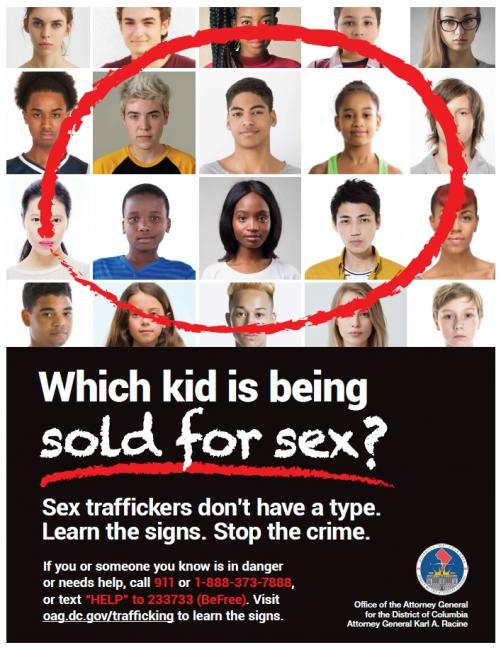
Traffickers have no rules about who they want to traffic. While some races are shown to be targeted more often, every human regardless of race, gender, and sexual orientation all has chances to be targeted. With this being known the United States has set up many different programs across the nation to try and educate all potential victims. Some of these programs are run in schools such as, “ARTREACH”. ARTREACH is a program for interactive simulations to teach students aged 8 to 18 about all the warning signs and tactics used by human traffickers.  There are also programs for high schoolers that are 90 minute long prevention programs to educate the students on how to identify themselves or friends as potential victims. There are multiple programs all across the nation to try and help the youth fight and learn about human trafficking.

Human Trafficking Initiatives | Attorney General Karl A. Racine

Human Trafficking Initiatives

Although there is no rule book for who traffickers will target there are some things that make one more vulnerable to trafficking. Some of these things are having an unstable living situation, looking for a better life, ran away, facing poverty, and/or addicted to drugs or alcohol. These are just a few things that make people vulnerable, you can read and learn about more traits here.

Who are the traffickers

Traffickers are the ones who “exploit others for the profit gained from forced labor and commercial sex. They lure and ensnare people into forced labor and sex trafficking by manipulating and exploiting their vulnerabilities.” In most situations, they promise a better life to the victims. They also can work entirely alone or be a part of a huge network of traffickers (ring). Traffickers can be anyone. They can be a family member, a friend, a spouse, or just a stranger. When looking for signs be open that they could come from anyone. In trafficking cases, the National Human Trafficking Resource Center has found that examples of traffickers include. Fake business owners, gangs, factory owners, and intimate partners along with many others. Many traffickers also may appear very possessive over their companion and never let them talk. Another trait of traffickers is that there vague about their profession and where they live.

Know The Signs

There are many different ways that traffickers try to lure in vulnerable victims. The main way that they do is buying telling intricate stories. Stories that involve a future romance or an amazing job that will fall into your lap if you trust them. The stories sometimes can be red flags enough however to a vulnerable victim it may seem like paradise. Some examples would be when getting a new job the new employes says they will have to move but is very vague or promises things with no evidence or backing. These are just some examples of the “recruitment” of the victims. Now we will talk about how to recognize trafficking past the recruitment stage.

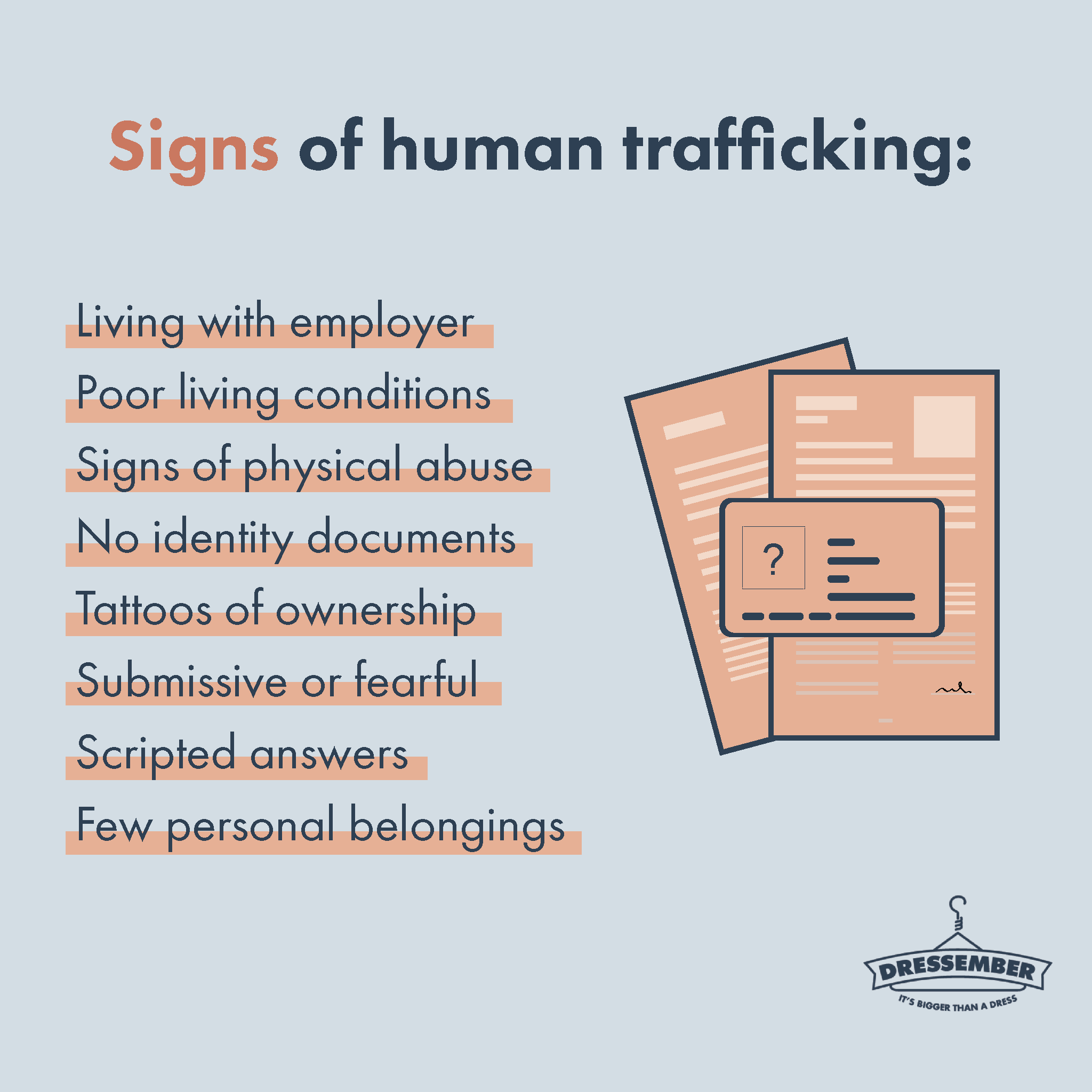
When it comes to labor trafficking one would look for signs like a worker staying in a job even though they have said they wished they could stop, they owe money to an employer, are living with an employer, become cut off from friends and family when starting a new job. Including other things like known threats from the boss and forced to work/live in dangerous conditions.

In sex trafficking, some signs are commercial sex workers who want to stop but are unable to stop due to fear. Other signs are those who live where they work, a child living dependent on a family member with a substance abuse problem, having a controlling contact who will not allow them to meet up and talk freely with others alone. Other more simple signs are a child that stops attending school, a complete change of attitude, various bruises with no explanation, and/ or shows signs of denied food or care. Sometimes someone may have none of the signs I listed here so it is very important to go with your gut if you are ever nervous about a situation.

What are the signs of human trafficking?

Dressember

Where to File Tips

It is important that people are educated about the signs of human trafficking along with where to file a tip. Past human trafficking victims have talked about the number of people they have passed while being abducted. If those people they passed would have been educated about the signs they could have been saved earlier. Almost every victim that had been saved was due to someone seeing and knowing the signs of human trafficking. If a sign is ever visible one should contact the National Human Trafficking Hotline or call 1-888-373-7888.

Think before you shop

Another way that the public can help reduce human trafficking is by thinking before they shop. Supporting brands that do fast fashion can simultaneously lead someone to support the human trafficking labor industry. Many fast fashion companies put their employees under harsh conditions and long hours with a very small payout. This includes over 170 million children who are engaging in child labor for fast fashion brands. So one way to help would be to stop giving your money to fast fashion brands and instead begin to do research and support sustainable brands. 

Sources

Dressember. “A List of Anti-Trafficking Curriculum for Educators.” Dressember, Dressember, 5 Mar. 2020, www.dressember.org/blog/educators.

“Human Trafficking Initiatives.” Human Trafficking Initiatives | Attorney General Karl A. Racine, oag.dc.gov/public-safety/human-trafficking-initiatives.

“Indicators of Human Trafficking.” Department of Homeland Security, 18 Dec. 2020, www.dhs.gov/blue-campaign/indicators-human-trafficking.

MacDonald, Natalie. “Fast Fashion & Labor Trafficking.” Unbound Global, Unbound Global, 20 Nov. 2020, www.unboundnow.org/blog/fast-fashion-amp-labor-trafficking.

“Recognizing the Signs.” National Human Trafficking Hotline, 31 Aug. 2020, humantraffickinghotline.org/human-trafficking/recognizing-signs.

“The Traffickers.” National Human Trafficking Hotline, 26 Sept. 2014, humantraffickinghotline.org/what-human-trafficking/human-trafficking/traffickers#:~:text=Traffickers%20exploit%20others%20for%20the,manipulating%20and%20exploiting%20their%20vulnerabilities.

Human Trafficking

Back in high school, I did a research project on human trafficking. That spiked my interest and made me want to focus my civic issue blog on human trafficking. So what is human trafficking? Human trafficking is a crime that involves exploiting a person for labor, services, or commercial sex. It is very important to note that human trafficking is not only about trafficking for sex but also labor. While sex trafficking is the most profitable it is actually not the most common type of trafficking, rather modern-day slavery (labor trafficking) is. Another type of human trafficking although less popular is debt bonding. Debt bonding is when someone is forced to work in order to pay off a debt. Human trafficking affects not just women but children and men all over the world. However, 70% of people trafficked are women. Another common myth of human trafficking is that it involves movement. Trafficking does not have to involve moving a person from one area to another, it can happen all while the person still lives at home. This occurs in situations when young children are put to work endless hours in factories with little to no pay, all while still residing with their families. That child is apart of human labor trafficking even though there is no movement involved.

I believe this is an issue that is not talked about enough as there are 600,000 to 800,000 people being trafficked a year. There are also estimates that over 20 million people are in some form of modern-day slavery right now. To me, this is a crazy statistic with not close to enough information talked about in the world. It is one the largest dark figures of crime, meaning not known to the police. Many cases go on without any identification of law enforcement.

I want to begin with some statistics about human trafficking. The main reason human trafficking Is so popular is because of the low risk and high reward. It is the third most profitable crime, following behind drugs and arms trafficking. It brings about $150 billion a year, $99 billion of that being from commercial sexual exploitation. Trafficking for labor allows for traffickers to “save” costs while trafficking for sexual reasons allows them to make a profit. A scary statistic involving sex trafficking is that over 50% of active human trafficking cases in the use are sex trafficking cases involving children. Social media plays a large part in this as traffickers are able to easily catfish young naive children into trusting them. This allows them to easily coerce the children to do what they ask. Another big thing about human trafficking is that it is everywhere. Many believe it is only in third world countries but that isn’t true in the slightest. It happens all around the United States, specifically Texas, California, New York, and Florida. It even happens in very affluent neighborhoods, for instance, Fairfax County the third richest county in America busted a large human trafficking ring in 2019. As a past student from Fairfax County, I had no idea this even happened. This care particular shows how trafficking can occur anywhere and is not talked about enough.

You may ask what has been done? The answer? Close to nothing.

In the entirety of 2016, there were only 14,894 prosecutions and 9,071 convictions for trafficking globally. While at first glance that may seem like a lot, remind yourself that over 600,000 people are trafficked a year! The United States has put effort to stop human trafficking however it is so large and secretive that little result has come. It is also very hard to take down an entire human trafficking business as the people who are frequently caught are just a small piece of a much larger puzzle. The ones caught can usually be easily replaced by the organization leading to little to no impact on human trafficking cases. Another reason that there is little prosecution globally is that in some countries there is no anti-trafficking legislation, and if there is law enforcement does not know how to enforce it.

Most policies the United States has in place helps trafficking victims after the event had occurred. For example, The Victims of Trafficking and Violence Protection Act of 2000, the first federal law in the United States to address sex and labor trafficking,  focuses on the three P’s prevention, protection, and prosecution. Human trafficking victims have specific needs due to years of trauma, lack of linguistic skills in the country trafficked to, and the struggle with basic functioning. The protection act allows victims to have Medicaid, food stamps, and housing subsidies. Also, foreign victims are helped through the process to give them legal immigrant status. Both types of victims are given educational training to help them in day to day life and to find jobs. It also aims to educate people on the signs of human trafficking and what they can do to help prevent it.

Next time I will dive into what everyone can do to help prevent human trafficking.

I have attached the national human trafficking hotline just in case. 1 (888) 373-7888

Skip to toolbar