• Log In

Urbane Jungle

In a world of towering brick and concrete edifices, sometimes one needs a little bit of plant life

  • POSTS
  • WELCOME

Tradescantia: Wonderful Wanderers

02.07.2018 by rzr5355 // 1 Comment

A Tradescantia zebrina quadricolor specimen as featured in Plant Rescue‘s post entitled “Tradescantia zebrina.”

Solid, striped, or variegated; burgundy, emerald, lilac, and (sometimes or) white; and almost always pointed. The leaves of Tradescantia species come is a vast array of appearances and hues which dazzle the eye and draw many a plant-lover near. Now, these unique descriptions may cause you to believe that these lovely specimens are rare pieces of small gardening collections hoarded away from the eye of the general public; however, it is rather likely that you have encountered at least one cultivar of this ever-popular genus in your wanders through the wilds of your local gardening center.

All About Tradescantia

Known more widely as inch plant, spiderwort, or “wandering jew,” Tradescantia are a genus of around seventy-five perennial flowering plants native to the regions between Canada and mid-South America. The genus became more well-known during the 1600s, during which foreign trade introduced the prior unknown beauties to Europe. It was during this very same period that the genus’s popularity began to take root and, subsequently, these colorful, winding wonders trailed their way into the hearts of green thumbs and the environments of locales across the globe. This, unfortunately, has caused some species to become invasive and cause unrest in those ecosystems where it survives a little bit too successfully.
(A kind thanks to Wikipedia for giving me the most quintessential knowledge I can’t seem to dig up on more “academic” sites!)

If you are anything like me, you are likely wonder why in the dickens these plants are known as “wandering jews.” Jackie Rhoades of Gardening Know How shares the story of the namesake in the post “Growing Wandering Jew Houseplants.” Simply put, women of the home we quite adept at growing the plants and would share their clippings with one another, thereby allowing the houseplant to spread in a manner similar to that of historic members of the Jewish community.
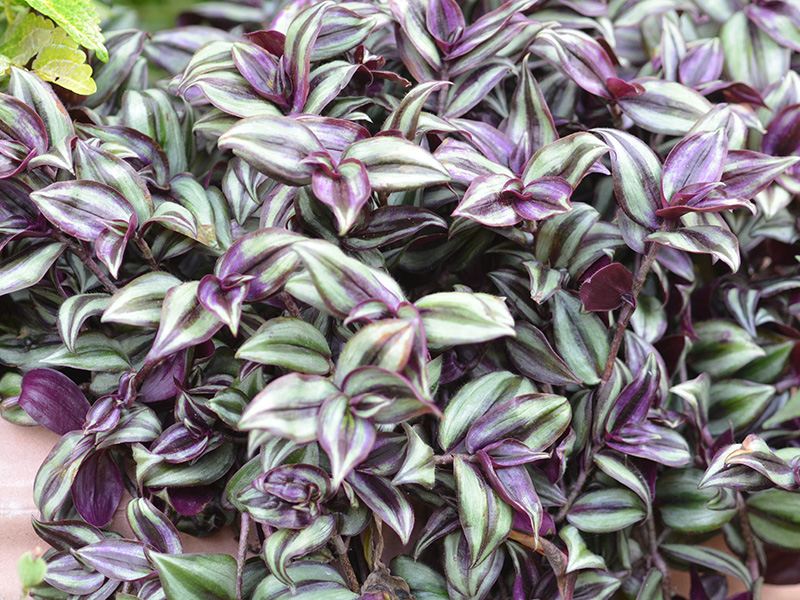
Tradescantia zebrina, as seen in World Plants‘ post “Tradescantia zebrina (Inch Plant, Wandering Jew).”

Care

Tradescantia are widely known to be of insubstantial need; they are, in nature, wildflowers which trail and vine, after all. Despite the this self-preserving, low-maintenance facade, though, some small eccentricities have slightly swayed the genus’s total ease of care and necessitated a tidbit of attention on the part of jungle caregivers.

For Tradescantia, the most basic requirements, soil, is of equally basic need. Genus members grow best in a well-draining general purpose potting soil, but they can also do extremely well in soilless mediums as a result of their abilities to drain. Container size is not typically an issue and many cultivars can be placed in hanging baskets or pots one size up from their nursery pots to contain their growth.

One such peculiarity comes in relation to the watering preferences of the plants: they really don’t like wet feet and really, really don’t like to be watered at the base of their stems, known as the crown of the plant. At this point, you have probably heard my spiel about root rot and how plants (usually) don’t like to have water sitting in their containers; this also applies to Tradescantia. Beyond these small finicky pieces, the genus likes to be watered deeply, drained well, and misted to raise the surrounding humidity. During the dormant season (winter), watering should be reduced to accommodate for the plant’s growth stagnation, though.

Fertilization of the plant is not entirely necessary, but can be done up to twice monthly with a diluted solution of general-purpose houseplant fertilizer.

The sunlight and temperature requirements of Tradescantia are straightforward. All members of the genus prefer bright, indirect sunlight with the occasional glance of full exposure and all will grow steadily in temperatures ranging between 55 and 75 degrees Fahrenheit.

Unfortunately, Tradescantia are known be become elongated and “leggy” with time due to their trailing nature. Many growers, including The Spruce, suggest pinching the plant to encourage branching of the plant and ensure fullness. When the plant becomes too stretched, though, the issue can be addressed by taking plant cuttings, rooting them in water on a sunny window sill, and replanting when the new roots have grown to one inch in length. For more precise details about propagating, head over to SF Gate‘s post on Wandering Jew Propagation!

Categories // Uncategorized

Spider Plants: Lustrous Leafers

01.31.2018 by rzr5355 // Leave a Comment

Chlorophytum comosum “Vittatum” as featured in the Mother Nature Network article (authored by Julie Knapp) entitled “15 Houseplants for Improving Indoor Air Quality.”

Odds are, you’ve seen quite a few spiders in your time (no, not those lovely, eight-legged organisms we share such disparate sentiments towards) in any number of locations. Doctor’s offices, hair studios, and office buildings are only a few meager examples of where “spider plants” can be found; the vastness of this locale list itself indicates the wide popularity of the genus. Although their common name may not hint at the quantity of positive reception Chlorophytum receive, they have, in fact, been popular houseplants for a few centuries due to their ease of care, visual aesthetics, and tendency for reproduction.

The flower of a spider plant with a premature spideret attached, as appears in Gardening Know How‘s Post “Spider Plant Flowering.”

Brief History

Chlorophytum are a tropical genus in the lily family that hail from southern Africa. These leafy beauts were first discovered by the Swedish naturalist Carl Peter Thunberg in 1794 and were introduced to Europe not soon after. According to the University of Arkansas Cooperative Extension Service, records dating to Victorian England associate spider plants with the affectionate nickname of “ribbon plants,” which arose as a result of their lengthy, striped leaves and striking similarity to the fashion features of the time. However, the more generally-known name of “spider plant” stems directly from the numerous offsets healthy plants produce, which hang from their parent plant in a manner similar to how spiders dangle from their webs.

The popularity of the spider plant as an integral feature of most indoor jungles is also traceable to the Victorian era, during which the presence of indoor specimens rose within the parlours of more opulent members of society. Favor of the genus has not diminished since, and, during the nineties, these springy sprawlers made their way into the macrame hangers you may have seen, yourself.

A Chlorophytum comosum “Variegatum” specimen with many a spideret, as featured on Jungalow’s post “Plant-o-Pedia: Spider Plant.”

Care

As prior stated, Chlorophytum are one species of plant that supply a whole bunch of visual appeal for an almost-negligible amount of care.

Let’s start at the root of the issue and begin with proper soil and potting (or re-potting) procedures. Chlorophytum do best in well-draining, “soil-less” growing substrates, a characteristic contributable to the genus’s natural habitat. Spider plants can be placed in containers one size up from that in which they came if you wish to re-pot after adoption. There is a trivial amount of fear of root binding when dealing with Chlorophytum, and it is only truly necessary to transplant a specimen if it becomes extremely root-bound. When this time comes, though, it is best to trim the plant’s roots, work some of the old soil that may be caught between them, and replant in a pot one size up from its original container (with fresh soil!).

As you may have deduced from the soil conditions in which Chlorophytum flourish, the plants within the genus do not require exorbitant amounts of water. Over-watering is (surprise, surprise) a primary issue when dealing with genus members, and plants should be watered when the top two centimeters of soil are dry. This can be reeled back slightly in the semi-dormant months (winter) to allot for the decrease in the plant’s growth cycle.

Chlorophytum fertilization is not a particularly tremendous concern, and specimens would benefit from fertilization three times per year. Water-soluble fertilizers are most acceptable at half strength, but any persuasion of plant food should be low in boron and fluoride-free.

Due to their tropical associations, spider plants are receptive to changes in temperature and values that are typically “low.” The optimal temperature range for the genus is an agreeable 65°F to 90°F, and should be kept well above the 55°F danger mark. In regards to other air quality concerns, Chlorophytum favor humid air conditions and will thrive if kept in a bathroom with ample sunlight.

The definition of “ample sunlight” as used above entails moderate, indirect light. South- and east-facing windowsills provide prime locations for spider plants given the amount of sunlight they receive, but west-facing sills should be avoided due to the intensity of afternoon sun, which could scorch the plant’s leaves.

Unfortunately, spider plants fall victim to the usual infestations and infections, up to and including: aphids, mealybugs, spider mites, white flies, and root rot (from over watering). Specialized care can be taken against these pests, and for those which cannot simply be rinsed off, neem oil is an effective, natural method of treatment.

Categories // Uncategorized

Pachira aquatica: Trees of Prosperity

01.23.2018 by rzr5355 // 3 Comments

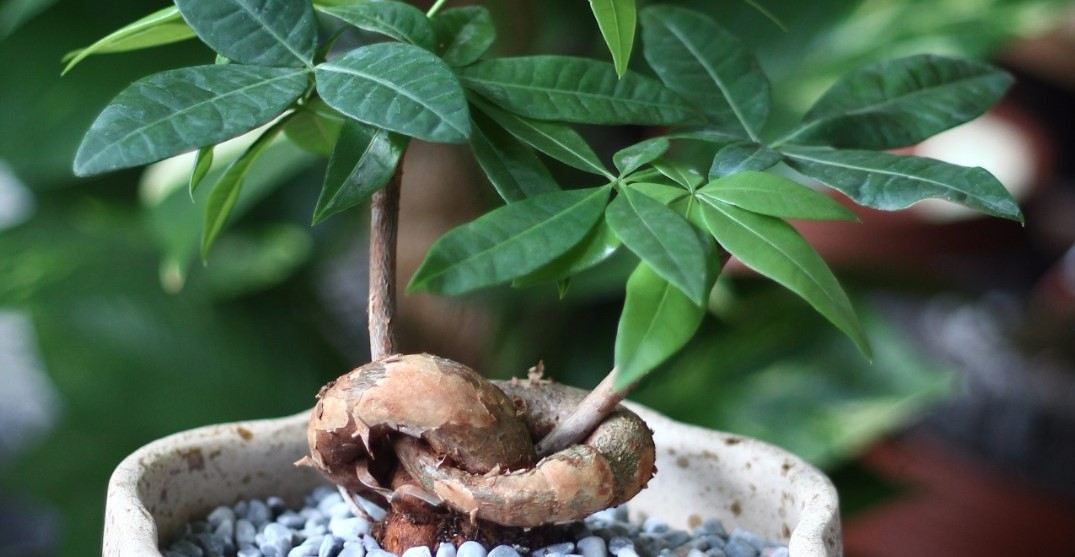
A beautifully braided Pachira aquatica specimen as posted for sale on Carousell by plant.in.

Many, even those of us who are not particularly green of thumb, know of the “money tree;” its characteristic braided trunk and meaningfully-numbered leaves have allowed Pachira aquatica to wind its way into the minds of bonsai enthusiasts and houseplant lovers alike.

Origins

Pachira aquatica is a species of wetland tree found in the tropical rainforests of Central and South America. Not surprisingly, the species follows the “natural growth” trend of houseplant trees, in which the outdoor-growing members of the species raise to heights far greater than those of their indoor counterparts. Where most urban specimens of Pachira aquatica may scrape 2 meters, their unbraided (and thus uninhibited) cousins can achieve heights of 18 meters, as allowed by SF Gate.

However large the natural version of these prosperity-bringing trees may grow in the wild, they can, under proper bonsai training, be as small as twenty centimeters tall. As shared by Bonsai Outlet, the true
“money plant” known and loved today originated in East Asia after a man’s “prayers for money” were answered after he discovered the plant and began cultivating and selling it. It was in Japan, though, that the plant truly grew in popularity after bonsai masters took to braiding (or knotting) the trunks of multiple specimens together.

A group of young Pachira aquatica trees in small, houseplant-sized pots, as featured on the website of It Meng Landscaping and Construction.

Care

In regards to the care of indoor Pachira aquatica, much can be deduced from its tropical nature (and possibly even from my prior posts on related topical trees such as Ficus lyata) and subsequent rankings as “easy to care for” by any and all plant care blogs one may encounter online.

The most basic care requirements of any specimen come from their soil medium and housing (potting) conditions, and Pachira are no exclusion. Given the well-draining nature of the soil these trees enjoy in their natural habitat, those that are pot-bound should be planted in a soil mixture similar to that of succulents and cacti, that is, a mixture composed of respective parts earth or peat moss, pebbles or vermiculite, and river sand. Such porous materials will allow water to pass freely through the medium and will fend off root rot. Proper potting procedures for “money trees” vary based on the particular size of the specimen. Bonsai money trees require smaller pots and infrequently replanting (every two to three years with gentle root trimmings in the process), whereas larger, house plant-sized specimens needs only be transplanted every few years when they outgrow their previous pots.

Trees can be pruned (with adequately sharp shears, of course) to shape the growth of the tree at a more aesthetic level, and those who wish to grow their trees to larger sizes may continue to braid the intertwined stems until they have become sufficiently mature (stiff).

Water concerns are rather straightforward for Pachira aquatica and its natural tendencies require it be watered thoroughly only when the top layer (two to five centimeters) of soil are dry. As said prior, a well-draining soil medium will prevent root rot from standing water and possible over-watering. This is one note to that is of rather high importance, as over-watering is one concern that can derail the health of your prosperity tree!

Fortunately, bonsai versions of the tree do not require frequent fertilization and can be fed twice yearly in spring and autumn. Larger plants should, at most, be fertilized twice a month with a diluted (half-strength) water-soluble fertilizer.

P. aquatica‘s sunlight and temperature requirements follow similar topical tree trends: indirect sunlight, not enough to scorch the plant’s (semi-)delicate leaves, but not too little as to stifle specimen’s photosynthetic processes, and warm temperatures above 10 degrees Centigrade. It is also suggested (by each of the sources I have already noted above, in truth) that trees be rotated to ensure their upright growth and even light distribution and be kept away from areas with frequent drafts.

Although these charming plants may seem like unlikely victims of the most common houseplant pests, they are, unfortunately, not immune to their (unwanted) attentions.  The primary actors against indoor money trees are mealy bugs and spider mites, but these can be treated at the household level most easily.

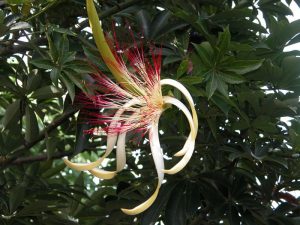
An image of the natural bloom of P. aquatica as found in its natural habitat, courtesy of The University of British Columbia.

May good fortune smile upon you and any money trees you may acquire in your journey through the urban jungle!

Categories // Uncategorized

  • « Previous Page
  • 1
  • 2
  • 3
  • 4
  • …
  • 6
  • Next Page »