The Constantly Changing U.S. Foreign Policy

When continuing our discussion on civic issues in politics, a major prevalent topic that we have not yet discussed is the United States’ Foreign Policy. Originally, the United States operated under a system of isolationism where the government attempted to avoid engaging in any outside conflicts that did not involve them. However, over the last 100 years, the United States has constantly changed with the rise of new leaders and ideologies.

For instance, until this month, the United States had been holding increasing responsibility as a global power. The United States created diplomatic relations with a variety of nations in an effort to promote democracy and trade. However, with President Trump’s inauguration, foreign policy has once again changed. According to The New York Times, “It’s not just a reversal of previous administration policies…but a reversal of the fundamentals of American foreign policy since 1945” (Broadwater). President Trump has attempted to resolve conflicts that the U.S. is involved in, and is currently attempting to reverse back to isolationism ideologies for foreign policy.
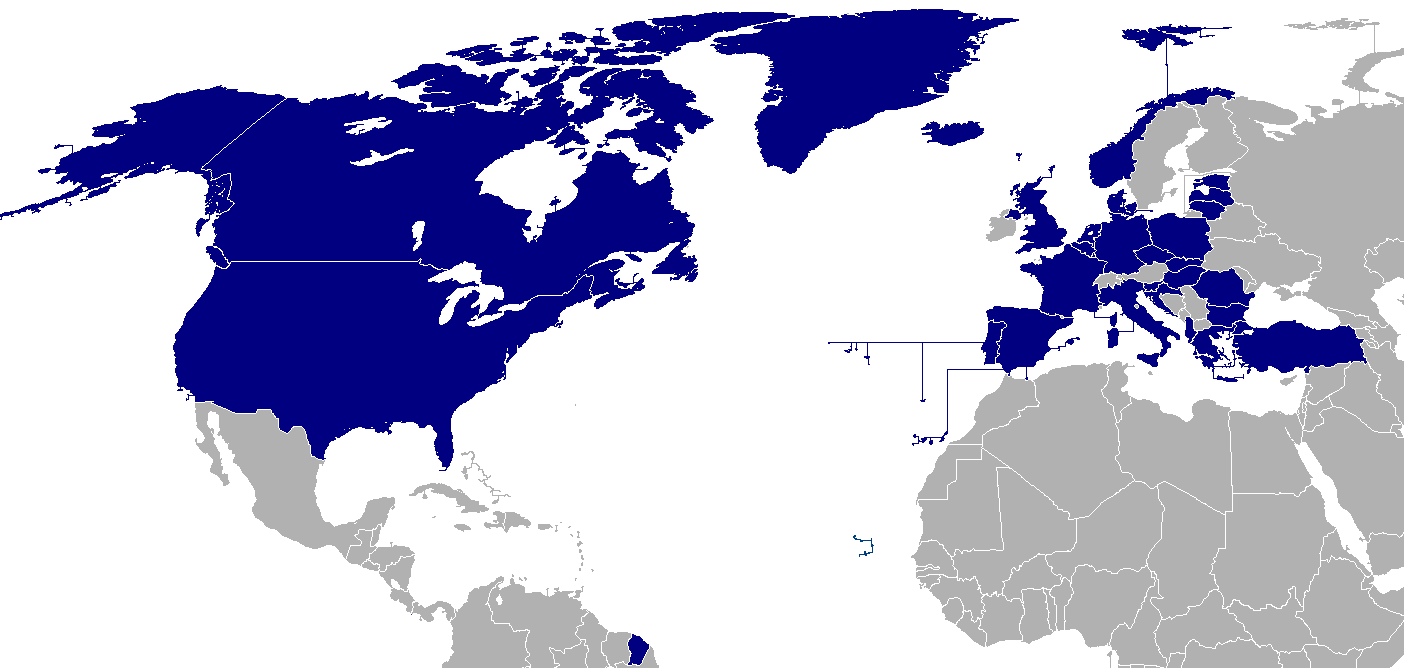
Top 14 maps and charts that explain NATO - Geoawesome
The United States’ efforts in promoting Democracy under NATO, an organization the United States helped create themselves (Source)

With this pattern of reversing toward isolationism, the United States has also decreased their aid to other countries. According to the Pew Research Center, President Trump has attempted to “…freeze foreign aid and shutter the primary agency that distributes it…” (Desilver). Not only has President Trump pushed for an isolationist policy, but he is attempting to push the United States toward focusing on itself by playing a lesser role in the health of other countries. This change will not only affect the economy of the United States, but globalized networks throughout the world.
Trump pauses all US foreign aid for 90 days; orders review; NGOs decry move | World News - Business Standard
Trump Freezing US Foreign Aid (Source)

Currently, there is no major common ground for foreign aid between both the Democratic and Republican parties. Just before President Trump was elected, foreign aid was much higher, as seen on the map. The Democratic Party and President Biden encouraged U.S. involvement in supporting third-world countries toward prosperity and growth. A few of the major countries supported by the U.S. in 2022 included Ukraine, Israel, and Ethiopia.

United States foreign aid - Wikipedia
Map Showing U.S. Foreign Aid Distribution in 2022 (Source)

This debate of the right foreign policy and just how much foreign aid the U.S. should be offering to other countries has been ongoing for several years because of the difficulty in creating one true answer that fits all situations. The change in policy and aid from President Biden’s Administration to President Trump’s Administration shows the vagueness of the line that justifies the United States’ role in globalized affairs/issues. Due to the lack of a “clearly defined line” for foreign policy and two political parties with vastly different views, it will likely continue to change in future decades. Furthermore, with these changes in foreign policy, there will likely be continued changes in foreign aid because of new global concerns (i.e. new conflicts and alliances). Thus, foreign policy will likely continue serving as a civic issue in politics for many years.

The Replacement of Bipartisanship by Polarized Views

When attempting to further examine modern Politics over recent years, bipartisanship is often revolving in the conversation. The United States has operated under a bipartisanship system for hundreds of years with two major parties: The Democratic Party and The Republican Party. These parties created platforms with opposing perspectives on current issues (i.e. Abortion, Gun Control, etc.)

US political parties and their support - How the US political system allows democratic participation - Higher Modern Studies Revision - BBC Bitesize
Chart showing opposing perspectives on current issues (Image Source)

However, this bipartisanship system has recently declined because of a rise in polarized values. According to The New Yorker, this polarization”…[was] more or less inevitable because of the speed of Internet communication, the inherently adversarial and mostly anonymous characteristics of online chatter and the isolation that comes with staring at a screen all day” (Kang). The social media algorithm and ability of users to choose who to communicate with anonymously greatly accelerated the decline of bipartisanship. Users began to only communicate with those who believed in similar political ideas, and this caused the users to much more strongly perceive that their beliefs are the only answer to an issue. Furthermore, certain platforms align themselves with one party, increasing the amount of content seen by users for that party compared to the other. With both of these features, individuals struggle to amend their perspectives to reach a common-ground with those who disagree, creating a polarized view.

Graph of Various Platform’s Political Bias (Image Source)

Similarly, this decline in bipartisanship and rise in polarized views can also be noticed during Congress votes. For instance, the vote on Obamacare in 2017 created many divided sides on whether Obamacare should remain instituted in the United States. According to CNN, “…the Republicans did not have a comprehensive plan to replace the landmark health care law and they couldn’t get unanimity in their party even for a pared-back attempt to hollow the act out.” Although Republicans were unable to pass their own law negating the Democrat’s Obamacare law, they were also unable to create any changes on it because of their own disagreements within their party. Furthermore, a variety of techniques such as presidential vetoes, filibusters, and anonymous holds further decreased the chances for compromise and bipartisanship. This lack of bipartisanship illustrates the rise of polarized views limiting compromise when attempting to settle major issues.

GOP Admits Years of Obamacare Repeal Votes Were a Sham
Congress Hearing on Obamacare (Image Source)

Despite this lack of bipartisanship, the government is still able to pass laws using the President’s ability for executive orders. For instance, certain presidents have targeted voting access and smaller improvements in the quality of life of citizens via these executive orders.

Overall, despite this decline in bipartisanship, I believe that the polarized views can be reversed through laws that limit techniques such as the Filibuster in Congress. Removal of these techniques will force both parties to find common-ground much more easily. Bipartisanship is important in the U.S. because it allows for different perspectives on solving key issues. These solutions will consist of new laws and practices that will improve quality of life for both current and future generations.