• Log In
 Visit the Pennsylvania State University Home Page

OLEAD 410: Leadership in a Global Context

Cultural Leadership blog

Euromaiden: Risks of Doing Business in Post-Post Cold War Ukraine

Ukraine is Europe

(Ogirenko, 2015)

Like many of the old Soviet countries, Ukraine is both independent from and dependent on Russia after the breakup of the former U.S.S.R. After the breakup, Russia formed the Commonwealth of Independent States (CIS) which are composed of the former Soviet countries including Ukraine. The intention of the CIS was to create an economic zone that was dependent on Russia, created a buffer zone of control between Russia and the EU and NATO states, and to continue to have access to the Black Sea and Mediterranean Sea (Allison, 2014, pp. 1255-1256). For Putin, the CIS was a way to keep control over the former U.S.S.R. states (Allison, 2014, p. 1257). This created a situation where both politically and economically, the CIS countries were being controlled by Russia and the political corruption was high. In Ukraine, the people saw this corruption and rejected it and their countries’ corrupt political elites that were under control of Putin starting a political shift now referred to as Euromaiden (Averre & Wolczuk, 2016, p. 551).

Euromaiden represented a nationalism and identity movement for Ukraine and a desire to control their own economy and grow ties with the EU (Averre & Wolczuk, 2016, p. 551). The protests, demise of the corrupt Ukrainian President Vitor Yanukovych and his government, and Ukraine’s movement toward the EU prompted Russia to assert control over parts of Southern Ukraine where Russian military interests are located and Russian culture overlaps (Allison, 2014, pp. 1255-1257). The populous Euromaiden movement wanted Ukraine to have a more European political orientation which renewed the NATO nation’s efforts to bring Ukraine closer to them, something Russia would not allow (Allison, 2014, p. 1257). Russia would not have a NATO nation on its border. Russia’s invasion of parts of Ukraine has hardened the relationships between Russia and the NATO nations resulting in further sanctions and a lessening desire to do business with Russia (Allison, 2014, p. 1259). 

In the short term, Ukrainian economy and trade remain closely linked to the CIS but in the medium to long-term, Ukraine is unlikely to create close ties with EU nor do the EU and NATO countries want to provoke a fight with Russia, who has clearly drawn a line (Allison, 2014, p. 1296). For companies, the opening of Ukraine to a Western oriented political structure and populous desire to create ties with the EU can open new markets but comes with great risks. Russia still asserts great economic control over Ukraine through the CIS (Allison, 2014, p. 1257). So to deal with Ukraine, a company must look at the CIS and Russia for ways to create business relationships. One emerging economic area in Ukraine is socially responsible businesses which are companies that are socially active in society with goals to align business strategies with socially responsible activity that improve the lives of society (Kornilova & Karashchuk, 2017, p. 446). Socially responsible companies can align well with the Euromaiden movement and carve out a niche in an uncertain future for Ukraine. There are still great risks with Russia’s assertion of control over parts of Ukraine and over its economy through the CIS. With international sanctions in place on Russia, doing business within the CIS may be difficult. 

References

Allison, R. (2014). Russian “deniable” intervention in Ukraine: how and why Russia broke the rules. International Affairs (London), 90(6), 1255–1297. https://doi.org/10.1111/1468-2346.12170

Averre, D., & Wolczuk, K. (2016). Introduction: The Ukraine Crisis and Post-Post-Cold War Europe. Europe-Asia Studies, 68(4), 551–555. https://doi.org/10.1080/09668136.2016.1176690

Kornilova, O., & Karashchuk, O. (2017). Socially responsible business in trade: further development in Ukraine and Russia. Problems and Perspectives in Management, 15(3), 445–452. https://doi.org/10.21511/ppm.15(3-2).2017.12

Ogirenko, V. (2015). A boy wrapped is a Ukrainian flag. [Photograph]. Atlantic Council. https://www.atlanticcouncil.org/blogs/ukrainealert/ukraine-two-years-after-euromaidan-what-has-been-accomplished/

The Cold War Connection of ‘The Americans’

The Cold War was a fascinating time in history because it pitted the superpowers of the United States and other allied nations against those of the Soviet Union and other communist countries. The governments spent decades trying to outdo one another regarding foreign policies, military force, science, and space. Although this is a straightforward explanation of the war’s impact, the Editors of History.com explain that after World War II, there was such a hostile atmosphere that no one nation was to blame and that even historians believe the period was inevitable (2009). It’s no wonder that television producers thought to create a dramatic program that fictionally focused on two Russian spies and their time in the United States. They completed dangerous assignments for their native country Russia. “The Americans” television program uses a mix of factual and fictional events to depict The Cold War connections between the superpower nations of that time.


“The Americans” was a period spy drama that focused on the later years of The Cold War, with Ronald Regan being President in the United States and Mikhail Gorbachev being part of the leadership of the Soviet Union for a large portion of the series. Although the show is fictional, it does provide some context on the misconceptions of the power dynamics between the United States and the U.S.S.R. As Edward Cohn explained in his The Washington Post article “What ‘The Americans’ gets wrong about the Cold War” “the show’s representation of Soviet espionage promotes a distinctly conservative narrative of the Cold War – one in which the Russian enemy is truly the “Evil Empire” engaged in the sabotage of American institutions” (2019). This is an interesting summation because it almost entirely ignores Hofstede’s cultural dynamics about both nations. (Although it should be noted that since the U.S.S.R no longer exist, this comparison is solely based on Russia and the United States).


According to Hofstede, “a high score in the masculine dimension indicates that the society will be driven by competition, achievement, and success, with success being defined by the winner/best in field” (2020). By comparing the U.S. and Russia, the U.S. outranks Russia 62 to 36. In this case, Russia’s low score pegs them as a more feminine society that does not want its members to stand out too much and expects that their achievements will be modest. Although this point can be debated, it can also be thought that the primary goals and values within Russian culture are for certain people to win big. At the same time, the majority of society is expected to be successful within their ranks. The higher score received by the United States determines that the U.S. is more concerned with any individual securing a win. This also relates to the power distance and individualism comparisons of the nations. While Russia has a higher power distance that distinguishes the country as one where few have power over the many, the United States considers itself more individualist. These themes repeat themselves on “The Americans” because time and time again, the audience witnesses how the show’s protagonists expect modest lives for themselves and consider their superiors as status symbols that do not necessarily have to categorize themselves with other Russians. Despite these cultural differences, the Cold War depiction in “The Americans” reveals that both the U.S. and the U.S.S.R were determined in their evolvement to advance their nations.


As Moran, Abramson, and Moran (2014) explain, “the U.S.S.R. did survive World War II, becoming a superpower that achieved some impressive accomplishments” (p. 494). The same occurred in the U.S. Both nations implemented and developed rigorous space programs. The editors of History.com state that the Soviets launched the world’s first artificial satellite, while the U.S. also did the same and created NASA.  Also, the nations made accomplishments in healthcare, education, and other innovations. “The Americans” details all of this through a lens that is critical of both the Cold War and the actions of spies and government operatives.


Despite the cultural differences, the Cold War did come to an end in the early 1990s. Through various actions, the nations’ leaders eventually secured their administrations’ necessary support to bring the hostile actions of their countries to a stop. For “The Americans,” this meant getting caught and having to return home to a country that was all but foreign. In his article “Peace, Yes, but World Freedom as Well”: Principle, Pragmatism, and the End of the Cold War, Travis Cram suggests that President Ronald Reagan used his skills, diligence, and the rhetorical context of the situation to manipulate the war to a close. Although this generalizes the role that the President played, by analyzing Hofstede’s cultural country comparisons, can anyone doubt that the United States’ masculinity and individualism would lead to the end of a hostile political rivalry?


References:

Cohn, E. (2019, April 01). Perspective | What ‘The Americans’ gets wrong about the Cold War. Retrieved November 20, 2020, from https://www.washingtonpost.com/news/made-by-history/wp/2018/03/28/what-the-americans-gets-wrong-about-the-cold-war/

Compare countries. (2020, June 08). Retrieved November 21, 2020, from https://www.hofstede-insights.com/product/compare-countries/

Cram, T. J. (2015). “Peace, Yes, but World Freedom as Well”: Principle, Pragmatism, and the End of the Cold War. Western Journal of Communication, 79(3), 367–386. https://doi-org.ezaccess.libraries.psu.edu/10.1080/10570314.2015.1035747

History.com Editors. (2009, October 27). Cold War History. Retrieved November 22, 2020, from https://www.history.com/topics/cold-war/cold-war-history

Moran, R. T., Abramson, N. R., & Moran, S. V. (2014). Managing cultural differences. Abingdon:   Routledge.

Pennsylvania State University (2020). Lesson 13: Eastern Europe and Russia. OLEAD 410: Leadership in     Global Context. Retrieved from https://psu.instructure.com/courses/2075490/modules/items/29697221

Old Made New Again

Vladimir Putin once famously said “Whoever does not miss the Soviet Union has no heart. Whoever wants it back has no brain (Weiss, 2012).” This sentiment speaks directly to the comparison of the “old” Russia and the new. The boundaries are not always as clear as one would expect and the experience is clearly cultural.

Consider the longevity of the Soviet Union. From 1918 until its collapse in 1992, untold millions were born, lived long lives and died under the sickle and hammer. Paired with ubiquitous nature of communist government, this most certainly has a lingering cultural effect that will likely shape the region and its people for generations to come. As an example, in 2000 the newly “democratic” Russian Federation re-adopted the Soviet national anthem from 1944 after a few minor edits with the approval of two-thirds of the population (Eremenko, 2015). Though long gone, the Soviet Union lives on in Russian culture.

Understanding how cultural considerations effect interactions is critical in the region. “In general, it would be much wiser to develop a strategy to lead in this region based on the cultural factors of eastern Europe… (OLEAD 410, n.d.)” and that is impossible without also considering the legacy of the Soviet Union. “To acculturate the peoples of former communist countries to real democracy and a market economy is a massive reeducation challenge that will take many decades (Moran, Abramson, & Moran, 2014).”

Though European in many respects, Russia is not “the West.” Understanding the unique cultural bridge between Asia and Europe requires an understanding of the complex sociobiology of the regions inhabitants, the connection among Slavic peoples across international borders and the legacy of communism and the Soviet Union.

_________

Eremenko, A. (2015). Back in the U.S.S.R.? How Today’s Russia Is Like the Soviet Era. Retrieved from nbcnews.com: https://www.nbcnews.com/news/world/back-u-s-s-r-how-todays-russia-soviet-era-n453536

Moran, R. T., Abramson, N. R., & Moran, S. V. (2014). Managing Cultural Differences. New York: Routledge.

OLEAD 410. (n.d.). Demonstrating the Connection Between Eastern Europe and Russia. Retrieved from psu.edu: https://psu.instructure.com/courses/2075490/modules/items/29697222

Weiss, A. (2012). Five myths about Vladimir Putin. Retrieved from washingtonpost.com: https://www.washingtonpost.com/opinions/five-myths-about-vladimir-putin/2012/02/29/gIQAchg8mR_story.html

Russia and Europe: Needed Unity

In recent years, it has not only been Europe, but also Russia which has radically changed. With the collapse of the USSR IN 1991, the geopolitical status of Russia changed from the great empire that it was in the Soviet period to a power that makes considerable efforts to prevent the withdrawal of those countries that declare their allied relations with Russia. Undoubtedly, Russia’s relations with the former Soviet republics cannot be viewed in isolation from the influence that other geopolitical players have on world politics. Among them, the European Union plays a special role in Russia’s foreign policy. Since some CIS countries show interest in the EU as a priority for them, it should be emphasized that building long-term and productive relations between Russia and the countries of the European Union is one of the key factors not only of a pan-European, but of the world security system.

Given the fact that Eastern Europe is an assembly of countries with very diverse interests and tactics, it is noted that relations between Russia and each of these countries has developed individually. Relations with the countries of Eastern Europe are almost exclusively developed through economic interactions and the dialogue is almost entirely of political transactions. For example, the last meeting between the Czech and Russian foreign ministers took place back in 2005. At the same time, even amid conditions of reduced cooperation, which is largely due to the Eastern European countries lacking genuine political independence, there may be some positive dynamics. From 2016 to 2019 mutual trade turnover between Russia and all countries of the region grew. Direct deliveries of Russian hydrocarbon to a number of these countries only last year (Ofitserov-Belski, n.d).

As long as the Eastern Europeans have a variety of international partners with an interest in their well- being, there is no reason why they should not also try to develop suitable relations with Russia, the relationship should be centered on independent equality and mutual benefit. However, at the moment, it seems almost difficult for the right choices to be made. The West can either accept that Russia has a ban over the foreign policy direction of its neighbors or declare the right of the six states.

Conceivably, the most Europe can do is peacefully build up the resilience, while patiently talking to Russia in the hopes that some future Russian leader will accept that it is in both Russia’s interest and Europe’s interest that their shared neighbors are successful, established and well-governed. By the time any Eastern European state qualifies to join a Western organization even Putin will have given way to another Russian president, perhaps with a different stance.


Reference:

Ofitserov-Belskiy, D. (n.d.). Analytics. Retrieved from https://valdaiclub.com/a/highlights/russia-eastern-europe-paradox-of-relations/

French Contradiction of Scores in Power Distance and Individualism

The attitude toward work and business is quite different in French culture than in the United States. These differences become apparent when examining a publication written for a regionally specific audience, as I was researching topics covered in chapter 14 of Managing Cultural Differences, I stumbled across Forbes France. I found reading what I typically thought of as a U.S. only magazine with articles and tips about to navigate business from the perspective of a native author from another culture very intriguing.

Many of the latest articles from Forbes France, discussed our current global situation brought on by COVID-19 and the need to work remotely. French leaders have a very different struggle than those in the States; France has a power distance score of 68, which is high and indicates a preference of hierarchical structure within an organization (Hofstede Insights, n.d.). Employees have a high level of dependency on their leaders for constant direction, but how does that translate when working remotely? Micromanaging employees from a distance is a cause for great concern and is stressed as fear of “losing control over their employees” (Forbes France, 2019). Working remotely requires a high degree of independence, this may be an issue from the management’s point of view, but France also has a high score in individualism. With a score of 71 in individualism, this makes for a unique combination; generally, high power distance cultures are collectivist (Hofstede Insights, n.d.). The French declare they hold fellowship and equality as central points of their culture, but the high score in individualism states otherwise (Moran, Abramson, & Moran, 2014). The conflict in these scores indicates subordinates respect and show compliance to their boss’s demands, but when left to their own devices may do the opposite of what they have committed to, as they believe that they know better (Hofstede Insights, n.d.). As the weeks of quarantine have progressed requiring the adoption of telework practices by the majority of the French workforce, the view of the primarily U.S. practice has changed from ridiculous and unacceptable to a means of achieving increased productivity and work-life balance (Forbes France, 2019; Midena, 2020).

Differences in business behaviors and practices are evident and can be examined not only by applying behavior and cultural theories, such as Hofstede’s six cultural dimensions, but by comparing articles in the same publication for different regional audiences. Forbes is a business magazine published in 55 countries and features articles written about leadership and management from the cultural perspective of the local culture. I found it very interesting to read business articles from another cultural view. With the help of google translate, I think I will continue to explore other regional business practices through similar sources while applying lessons from this course. 

References

Forbes France. (2019, October 21). Etats Unis VS France : Des Leviers De Motivation Au Travail Différents. Retrieved from https://www.forbes.fr/management/etats-unis-vs-france-des-leviers-de-motivation-au-travail-differents/?cn-reloaded=1

Hofstede Insights. (n.d.). Country Comparison. Retrieved from https://www.hofstede-insights.com/country-comparison/france/

Midena, M. (2020, April 8). Télétravail Intégral : L’Exemple De Fizzer. Retrieved from https://www.forbes.fr/management/teletravail-integral-lexemple-de-fizzer/

Moran, R. T., Abramson, N. R., & Moran, S. V. (2014). Managing cultural differences (9th ed.). Oxford: Routledge.

Russia and China’s Strategic Partnership

China-Russia relations have been said to show strong vitality and broad prospects after weathering the changing international landscape throughout the past seven decades and have become an example for a new type of major-country relations featuring close cooperation, partnership instead of alliance and dialogue, instead of confrontation. The China-Russia comprehensive strategic partnership of coordination for a new era has become a major-country relationship featuring the highest degree of mutual trust, the highest level of coordination and the highest strategic value. This partnership does not target any third party and will not be affected by any third party — to worried minds in the West.

Russia has been assisting China with defense projects such as a new missile early warning radar system to add new quality to the defense capability of their strategic partner. Although the missile early warning radar system being developed by the two countries for China’s use was defensive in nature, it signaled a new degree of collaboration for neighbors with a much longer history of mutual suspicion. Seventy years after establishing ties, Russia and China have overcome much of their Cold War-era bickering and both sides describe their ties as being the best they’ve ever been.  (O’Conner, 2019)

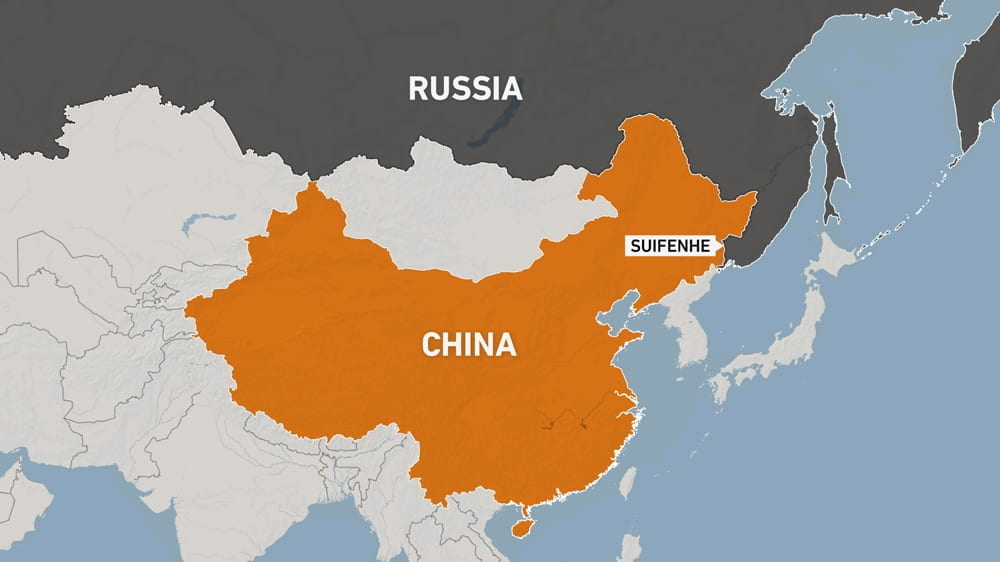
However, there is current unease at the actual border between Russia and China. More than 2,000 Chinese nationals crossed the land border checkpoint at Suifenhe before it was shut on 7 April. The influx of Chinese nationals returning from Moscow has turned the border town with a population of 70,000, into China’s new Covid-19 hotspot. Since Thursday, a total of 346 Chinese nationals returning from Moscow through Suifenhe contracted Covid-19. The total number of imported cases in China stood at 1,534 as of Thursday.

The shutdown of borders between the two countries has demonstrated the awkward situation China faces when dealing with an ally like Russia. The decision to close the borders came from Beijing’s concerns over growing domestic complaints that Russia had become the top source of imported Covid-19 cases in China. Beijing likely does not want to emphasise that a growing number of imported Covid-19 cases are coming from one of its most closest partners and both sides appear willing to downplay the unease at the border. (Yang, 2020)

References

O’Connor, Tom. (2019, December 20). Russia and China Seek No ‘Military Alliance’, Instead a ‘Stratetgic Partnership’ of the Most Powerful Kind.
Retreived from https://www.newsweek.com/russia-china-no-alliance-powerful-partnership-1478556

Yang, Tommy. (2020, April 18). Unease at the Border: Russia and China Seek to Downplay Covid-19 Outbreak in Suifenhe.
Retreived from https://www.theguardian.com/world/2020/apr/18/unease-at-the-border-russia-and-china-seek-to-downplay-covid-19-outbreak-in-suifenhe

Fresh baguettes and French racism

As we have learned, as a global leader it is important to learn the cultural norms of the country that you are doing business in so that you do not offend.  This concept is a wonderful concept for most business people to grasp when doing business in foreign countries, but what happens when those foreign countries that you are doing business discriminate against you?  As a black person, and especially a black woman, it is a harsh reality in the international business world. Often when booking vacations, we have to google “how is the racism in this country”, and when doing international business we must do the same thing.  


Moran, Abramson, & Moran (2014) describe the French as friendly and charming people who value personal honor and integrity.  When doing business in France it is important to note that French businessmen are not competitive and, like most of Europe, have a relaxed and fluid concept of time management.  As a black person doing business in France, it is also important to note that they are also….racist.  


Jacobs (2019) explains that France and Sweden are among the high discriminatory countries in Europe. The job discrimination in France and Sweden rivaled that the United States.  Jacobs (2019) states “On average, whites receive 65 to 100 percent more callbacks in France and Sweden than non-white minorities,” they report. “In Germany, the United States, and Norway, they receive 20 to 40 percent more.”  As a black woman future leader, those numbers do not give me hope that the business landscape in France will look anymore diverse than it does in America. The boardrooms will be filled with white men who will pretend to listen to your thoughts but will not fully consider them.


Alford (2020) says that France does not even keep any statistics concerning, religion, ethnic origin or race. This fact makes it very tough as a global leader to fully grasp the best practices when doing business in France.  Alford (2020) also goes on to say “there may be 3 to 5 million blacks in France.  But there are no black ministers (cabinet officials); no black ambassadors; no black senators out of 305; one black member of parliament out of 555; no black CEO’s among the top 100 companies; no black senior military officers among the top 100 executives”.  Business leaders must take the temperature of the racial climate in any country that they are doing business in especially if they have a diverse set of leaders and negotiators. While in business, one must become accustomed to the culture in which you wish to do business, it is also important to not send your leaders into a country that will diminish and demean them based on their race.  While the blacks in France are making strides to throw away the cloak of invisibility that the French seem to have cloaked them with, they still have an uphill battle.


References:


Alford, H. (2020). Blacks in France are Invisible.  National Black Chamber of Commerce.  Retrieved from https://www.nationalbcc.org/news/beyond-the-rhetoric/457-blacks-in-france-are-invisible

Jacobs, T. (2019). Hiring discrimination is greater in France and Sweden than in the U.S.  Pacific Standard.  Retrieved from https://psmag.com/news/hiring-discrimination-is-greater-in-france-and-sweden-than-in-the-u-s

Moran, R. T., Abramson, N. R., & Moran, S. V. (2014). Managing Cultural Differences (9th ed.). New York: Routledge

The Black Death: Medieval Period

Rats Didn't Spread the Black Death—It Was Humans - HISTORY

The medieval period is a time I really enjoyed learning about. One of the hardships that time period had to face was the black death. The plague killed more than 20 million people in Europe over a period of five. It started in Europe in 1347 when ships from the Black ship docked in Messina and it was discovered that most of the sailors were dead or greatly ill. The symptoms of the plague were, swelling as big as an apple, then came boils. The boils would cause blood or pus. Then people would experience a fever, chills, vomiting, diarrhea, aches and pains. All of theses symptoms usually ended in death. By the end of the 19th century it was founded by Alexandre Yersin had discovered that the black death was caused by a germ that was found in rats and fleas.

I find this part of the medieval times to be very interesting because of what we are going though right now with COVID-19. While the coronavirus is not as extreme as the black death. It is still a deadly disease that a lot of people don’t know a lot about. Just like in the times of the plague a lot of people didn’t know a lot about the disease except that people were dying. While we have better technology and are learning about COVID-19 more and more every day. It is still a scary experience for people.

The black death had healthy people doing all they could to avoid getting sick. “Doctors refused to see patients; priests refused to administer last rites; and shopkeepers closed their stores” (History, 2020). This text reminds me what is happening today. Doctors are only seeing patients after doing an over the phone interview to make sure they don’t have symptoms of the coronavirus and a lot of stores are closing to help stop the spread. Social distancing and quarantine were something that was also used during the medieval times. It appears we are taking a lot of the same precautions as those who were dealing with the black death.

The plague never really went away. We have antibiotics now that help, but It is said that there are still about 1,000 to 3,000 cases every year of the plague. Which when you think about it,  things like disease never really go away. We just find ways to cure them. Like with antibiotics and vaccines.


References

History. (2020, March 30). Black Death. Retrieved from History: https://www.history.com/topics/middle-ages/black-death


Ukraissan? Russainian? What?!

That blonde girl to the left of me? That is my best friend, Anna. We have been best friends ever since she arrived in my third grade class. My teacher had pulled me aside the week before and said, “Abby, we have a new classmate joining us next week, and I want her to sit next to you so that you can show her around and help her feel welcome.” Beaming with pride, of course I accepted, and as soon as little Anna stepped into our classroom, I excitedly patted on the chair of the desk next to mine and called out to her, “Hi! Over here!” Fast forward to over a decade later and even though, as she told me, “I thought you were totally weird at first,” we have been inseparable ever since.

So, what is different about Anna? She is one of seven children, with the oldest four (the fourth being her) having been born in Ukraine. As I grew up with her, I met her heavily accented parents and overheard her speaking to them on the phone multiple times–in Russian. Why not Ukrainian? This was my question to her as well. She explained, “In the part of Ukraine where my family is from, it is more common to speak Russian rather than Ukrainian, and I actually know more Russian because of that.” Wow…I thought. How is it possible and normal to just switch back and forth between the two like that? How do they even specifically know they are Ukrainian other than the fact that they are from Ukraine and not Russia? Being a native born American, I could not fathom how this worked.

Essentially, Anna and her family have a “mixed” identity in that they do not identify as uniquely Ukrainian. Instead, Russian language and culture has been a dominant force in the family’s life for as long as they can remember, and according to Valentina Feklyunina (2015, September 24) and her article regarding “soft power” in the Russia-Ukraine relationship, this is no coincidence. In attempts to solidify a definition of “the Russian world,” Russian President Vladimir Putin and other important political actors have concluded that Russians and Ukrainians have a shared past that unites them culturally, stating that they are joined together by Russian language, Russian culture, and Orthodox Christianity, among other deep-level factors (Feklyunina, 2015, September 24). Putting this into the context of Anna and her family, they speak Russian, practice many facets of Russian culture, and even attend an Orthodox Christian church, where sermons are given in Russian. Big surprise.

On an even deeper level, it is likely that Anna and her family share genetics that are shared across Russia and Ukraine, among other Eastern European countries. Given that Ukraine and Russia are geographic neighbors, it would not be surprising if parts of their DNA could be traced to both countries and others, contributing to the sociobiological nature of culture itself (The Pennsylvania State University, n.d.). This, therefore, lends itself to the evidence of Anna’s family’s blended identity as Ukrainian and/or Russian.

If you would ask her today, she would tell you that she identifies as Ukrainian, but she would also agree that “Ukrainian” no longer means that it is its own stand alone culture, but rather that for her and her family, “Ukrainian” means “born in Ukraine, but practicing Russian language, culture, and religion.


References

Feklyunina, V. (2015, September 24). Soft power and identity: Russia, Ukraine and the ‘Russian world(s).’ European Journal of International Relations, 22(4), 773–796. https://doi.org/10.1177/1354066115601200

The Pennsylvania State University. (n.d.). Eastern Europe and Russian Population. Retrieved November 20, 2019, from https://psu.instructure.com/courses/2008449/modules/items/27027028.

Russia and the Council of Europe

In response to Russia’s actions with regards to annexing Crimea in 2014 and its continuance in supporting the insurgency in Ukraine, the Council of Europe suspended Russia’s voting rights (Hall, 2019).  To protest this suspension, Russia stopped sending a delegation to the Council and stopped paying its dues in 2017.  Two years of nonpayment of dues can result in suspension or expulsion from the Council, and those two years will be up in two months.

It would be a shame if Russia left the Council of Europe, as it is Russia’s only judicial connection to Europe.  They utilize the European court to assist with human rights issues, and make up about 30% of the workload of the council.

Europe also does not want to loose Russia, but also does not agree with its actions and does not want to buckle to Russian’s demands.  To complicate it, Russia’s dues to the council make up 7% of the Council’s revenue.  Additionally, with Brexit looming, Europe does not need another be large change to contend with.

If studying Russia using Hofestede’s six dimensions of culture, it is clear that Russia is closely aligned with the values of European culture even though it is technically considered to be an Asian country (PSU, n.d.).  Given the similarities and shared culture of Russia and Europe, it would be a shame if they severed relations.  European leaders have the difficult task of evaluating the situation carefully, and strategizing an appropriate response that will make sense for both countries.

References

Hall, B. (2019).  Bring Russia back in from the cold, says Council of Europe Chief. Retrieved from https://www.ft.com/content/8158d52a-5496-11e9-91f9-b6515a54c5b1

Pennsylvania State University. (n.d.).  Lesson 13: Demonstrating the connection between Eastern Europe and Russia. In OLEAD 410: Leadership in a Global Context: Spring 2019 [Class module]. Retrieved from https://psu.instructure.com/courses/1964331/modules/items/25821742

  • 1
  • 2
  • 3
  • Next Page »

Recent Posts

  • Lesson Learned Blog Post
  • Germany
  • Blog 4: Economic development in Russia
  • My experience in GERMANY – Blog 4
  • Island Life and Tourism

Recent Comments

  • wje116 on My experience in GERMANY – Blog 4
  • jms7581 on Blog #4 Russia by Taylor Rasmussen
  • wje116 on Blog #4 Western Influence on Younger Generations of Japanese
  • kmb7437 on Blog #4 Western Influence on Younger Generations of Japanese
  • Julia Poston on Managing Virtual Cross Cultural Teams

Categories

  • Administration
  • Africa
  • Asia: Focus on China and India
  • Asia: Focus on Japan
  • Central America and Mexico
  • culture
  • diversity
  • Eastern Europe and Russia
  • Global Communication
  • introduction
  • Learning and Change
  • Middle East
  • South America
  • Synergy
  • Uncategorized
  • Western Europe

Archives

  • November 2024
  • November 2021
  • October 2021
  • September 2021
  • August 2021
  • April 2021
  • March 2021
  • February 2021
  • January 2021
  • December 2020
  • November 2020
  • October 2020
  • September 2020
  • August 2020
  • April 2020
  • March 2020
  • February 2020
  • January 2020
  • December 2019
  • November 2019
  • October 2019
  • September 2019
  • August 2019
  • April 2019
  • March 2019
  • February 2019
  • January 2019
  • December 2018
  • November 2018
  • October 2018
  • September 2018
  • August 2018
  • May 2018
  • April 2018
  • March 2018
  • February 2018
  • January 2018
  • December 2017
  • November 2017
  • October 2017
  • September 2017
  • August 2017
  • July 2017
  • June 2017
  • May 2017
  • April 2017
  • March 2017
  • February 2017
  • January 2017
  • December 2016
  • November 2016
  • October 2016
  • September 2016
  • August 2016
  • December 2015
  • November 2015
  • October 2015
  • September 2015
  • August 2015
  • April 2015
  • March 2015
  • February 2015
  • January 2015
  • December 2014
  • November 2014
  • October 2014
  • September 2014
  • August 2014
  • November 2013

Tags

Africa Body Language Change Climate Change Commitment Communication Cultural Synergy culture differences. OLEAD410 Diversity Germany global Global Leadership government programs Hello How to Inclusion integration intro Introduction Japan lady gaga Leadership learning Learning and Change in a Global Setting Lesson 6 life Maddy BigAngel Middle East minorties OLEAD OLEAD 410 olead410 OLEAD497B OLED OLED 410 Posting public sector Saudi Arabia school social social learning synergy thermodynamics Western Europe
 Visit the Pennsylvania State University Home Page
Copyright 2026 © The Pennsylvania State University Privacy Non-Discrimination Equal Opportunity Accessibility Legal