Category Archives: science

Loeb’s Behavior is Reckless

I’ve largely ignored Loeb for the past few weeks. When he started in on his 3I/ATLAS thing, there were plenty of mainstream media outlets willing to give his claims a wide and credulous platform, and it was important that there be clear communication from experts (or, at least, astrophysicists like him) about what, exactly, was wrong with his claims, and how to find reliable information on the comet.

It was also important, I felt, that both planetary scientists and the public understand that there is definitely a group of people working in Solar System SETI in a responsible and hype-free way, and willing to go to bat for good science in this relatively young and misunderstood field.

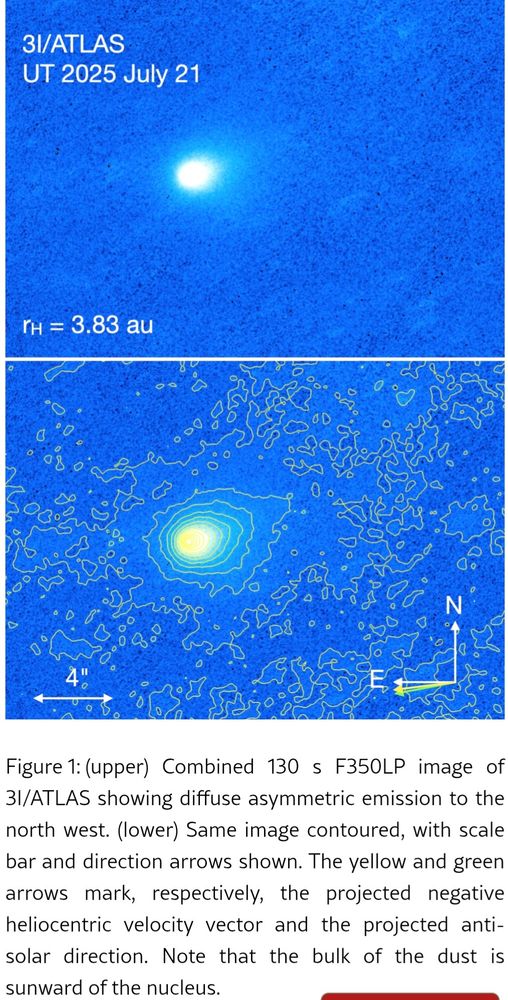
At some point, though, this stopped being useful: it seems that only the fact-free hype machines are platforming him any more, especially as his claims get more and more outrageous. I think photos showing it looking like an ordinary comet and not the death star have also helped casual observers of the debate understand that whatever these “anomalies” are they’re technical details about 3I/ATLAS doing very comet-like things.

Since I’ve got plenty of other things to do (I’m not in this for the attention, after all), I’ve been glad to put this down.

Some have argued to me strongly that even if he’s wrong, he’s getting people interested in 3I/ATLAS and that’s a good thing for science.

But it’s about a lot more than just Loeb getting the science wrong. Both Loeb and I get emails from very nervous people who follow his every blog post because they are very concerned that the comet will harm them, and Loeb is recklessly fanning their anxieties.

Here’s an exerpt from an email Loeb got:

All this is to say, I made plans (a moderate amount of long shelf-life food) after reading your initial 3I/ATLAS posts. More recent information (no cometary activity) brings to mind something Han Solo said… “I have a bad feeling about this.”

I have no illusions about our chances of survival if we are targeted for elimination, as per the Dark Forest theory. However, I would like to spend time with my family in the leadup to a potential encounter. I figure this will be a good thing whether or not all hell breaks loose.

Loeb did not exactly reassure them:

It would be a mistake to imagine a specific form based on scripts from science fiction writers, because their imagination, just like Large Language Models of Artificial Intelligence, is limited by their training data set on Earth. Even if we keep finding interstellar rocks, we should always be open to the possibility that one of the future interstellar objects might be technological. The nature of that encounter remains to be seen.

Here’s an excerpt from an email I got:

I’m a teen who has recently seen the stuff concerning the comet 3I/ATLAS and how it could possibly be of artificial origin. Since then I haven’t been able to stop thinking about it, and it’s giving me really bad anxiety.

There are more where these came from. For various reasons, I know a bit about anxiety, and how the irrational fears it creates can’t really be allayed through ordinary evidence. Especially when coupled with other mental health disorders this kind of anxiety can be crippling, and even dangerous. Loeb is doing many of his more fervent followers no favors with click-baity headlines like this one:

Is 3I/ATLAS a Friendly Gardener or Serial Killer? By Avi Loeb

Comets also have a long history of getting mixed up with religion and even cults. Comets have been seen as omens across cultures for millennia, and that’s still true today, most notoriously around Comet Hale-Bopp, which followed a very similar sequence of events to 3I/ATLAS.

An amateur astronomer observing Hale-Bopp mistook a background star for some sort of anomaly and called the credulous late-night radio show Coast to Coast to claim they had found an alien spacecraft following the comet. Soon co-discoverer Hale and others were hearing about apocalyptic warnings and concerns surrounding it.  Hale reportedly could see what was coming:

Hale says that well before Heaven’s Gate, he had told a colleague, “‘We are probably going to have some suicides as a result of this comet.’ The sad part is that I really was not surprised.”

Hale is referring to the Heaven’s Gate cult, which had 39 members commit mass suicide based on the comet’s apparition and belief it harbored a spaceship.

Loeb does not play down the religious implications of 3I/ATLAS being an alien spacecraft—indeed he was insinuating comets might herald the end of the world as we know it before 3I/ATLAS was even discovered. Back in 2023 he told the Jewish Journal of Greater Boston:

“In Jewish tradition,” said the Israeli-born Loeb, “We are waiting for the Messiah to arrive and bring a better future … I consider the possibility of the Messiah being extraterrestrial. Having a visitor from another planet outside the solar system could be a wake-up call for humanity.”

Back in March 2025 he wrote:

The arrival of superhuman intelligence at Earth could fulfill the longing for a Messianic age in Jewish eschatology, ushering peace, justice and prosperity on Earth. The agency of superhuman intelligence could either be in the form of Alien Intelligence or Artificial Intelligence, both abbreviated as AI.

and in an interview with Brian Keating:

A lot of Jews think that the Messiah might arrive from Brooklyn. I think that, the Messiah will arrive from an exoplanet.

He also tells us that he may have an important role to play here.  In August he suggested that 3I/ATLAS was a test of humanity—one that only he was passing:

Could 3I/ATLAS be the Turing Test of human intelligence by a superior alien Intelligence?

By that, I mean that an alien intelligence sent an anomalous object towards the inner solar system in order to test the level of human intelligence. If terrestrial comet experts insist that a technological origin of 3I/ATLAS is “nonsense on stilts, and is an insult to the exciting work going on to understand this object,” as argued by Professor Chris Lintott from Oxford university last month, then the evaluators can justifiably conclude that humans failed the test and do not deserve a high status in the class of intelligent civilizations within the Milky-Way galaxy.

In October 2025 Forward wrote about all of this, noting:

In a recent blog post, Loeb, who has previously likened his detractors to those who dismissed Galileo, Madame Curie and the Wright Brothers, compared himself to a Jewish child prisoner in Theresienstadt concentration camp who drew idealized images of a “better world” rather than the grim reality of a Nazi jail. Loeb noted that he and others who dream “of a better world than Earth” might “guide [humanity] to the promised land” by encountering aliens.

And Loeb wrote himself that month in a post about the massacre of people in Israel on October 6:

Given these sad thoughts, what is my hope for repairing the world?

It involves the urgent search for a package in our backyard that originated from a more advanced civilization. As I said in the Bergamo Science Festival in Italy on October 8, 2023 in response to a question from a brilliant young person in an audience of 500 people: “Humanity needs a better role model. As a practicing scientist, I am searching for an inspiring Messianic message, delivered in a bottle through the ocean of interstellar space from a more intelligent civilization that survived the danger of self-extinction and can teach us how to do better.”

So that brings me back to his now regular insinuations that 3I/ATLAS might be dangerous. Take for instance, this interview with Mayim Bialik back in September in which he warned about what might happen after 3I/ATLAS reached perhelion on October 29 (emphasis mine):

I got a text message the other day from someone who said that he is trading options on the volatility of the market with an expiration date of October 29th in order to make money and I immediately thought that I don’t know if there will be meaning to money if this object turns out to be technological after October 29th. If you want to take a vacation, take it before that date because who knows what will happen now. It could be a mothership that releases mini probes…

Given that he is using literally and openly apocalyptic language and implying that only he can properly see the magnitude of the potential danger or benefits from this heavenly visitor, and given how many people seem to be nervously hanging on his every post, I think he’s being quite reckless.

I will leave it to others to speculate on why he is doing this. I’ll just finish by noting that people with a platform as large and influential as his need to be more deliberate and careful about how their messages are received, especially when tracking well known scripts that have literally gotten people killed.

[Update: As if to prove my point, I just received this email:

In God’s eyes, Loeb, astrophysicists. and you are going to hell. The reason? For mocking God.

Your effort to attack your fellowmen using your idiotic logic in your latest 3I/ATLAS piece compels Me to email you. You have no love remains in your heart for anyone.

3I/ATLAS is to make sure someone who is day-in day-out disrespecting God, like you, are going to hell. And the finality of God’s verdict is not reversible.

3I/ATLAS shall arrive in the US on 31 August 2026. On that day, regardless of the US government participation, the National Emergency Worldwide shall be declared by Me from the White House.

I am not going to pretend that your life is going to be left unaffected. I will make sure your shamelessness will turn to shame.

King Paxhu Elohim,
The Kingdom of Heaven

Loeb is playing with fire.

]
3I/ATLAS is Still Intact and Still a Comet

Loeb is breathlessly reporting that 3I/ATLAS has survived perhelion intact, and is therefore probably an alien spaceship.  This is wrong.

His claim is based on a certain chain of reasoning that goes like this:

  1. He claims to have calculated the outgassing rate of 3I/ALTAS based on the gas ejection velocity and the length of its anti-tail here under the assumption that it is a comet:”Given that the jets towards the Sun were stopped by the solar wind at a distance of a million kilometers, I calculated here that their mass density is a few million proton masses per cubic centimeter at a distance of a million kilometers from 3I/ATLAS. The product of this mass density and the outflow speed, implies a mass flux of 5 billion tons per month per area of a million-kilometer on a side.”
  2. He then works out how much total gas 3I/ATLAS must have lost, and calculates the energy required to sublimate all that gas.
  3. He then works out how much sunlight strikes 3I/ATLAS and concludes that it must have an enormous surface area to have collected all that energy.
  4. He shows that the upper limit on the size of 3I/ATLAS rules out a solid object with that much surface area.
  5. The only way to explain this, he claims, is if 3I/ATLAS has fragmented into many pieces to increase its surface area
  6. He then argues that if it has not broken into pieces, then the comet hypothesis is disproven (or heavily disfavored) because being in pieces in the only way to explain the length of its tail.
  7. He then argues that if it is in one piece that this must mean that his original assumption is  wrong (proof by contradiction), and that the velocity of the outgoing gas is much higher than comets produce, and so could be generated by thrusters
  8. Ergo aliens.

I’m no planetary scientist so it’s hard for me to judge this, but fortunately some planetary scientists have taken the time to look at his math and it turns out he started off down the wrong path at step 1, in a really basic way.

In a BlueSky thread, Steve Desch explains that Loeb’s model for why comets have tails is simply wrong. Not just off a bit or missing a nuance, but wrong in a way that undergraduates taking a course in comets should be able to spot.  Here’s the thread:

Avi Loeb's calculations about 3I/ATLAS are 100% wrong because he has never understood that dust in the tail(s) responds to solar radiation pressure. Solar wind shapes the ion tail. But the radiation pressure is about 1000 times larger than the solar wind ram pressure, for particles that feel it.

Steve Desch (@deschscoveries.bsky.social) 2025-11-13T21:36:44.964Z

Basically, Loeb’s calculations assume the comet’s anti-tail is made of gas that is contained by the solar wind. In fact, the tail is made of dust that is sculpted by solar radiation.  These are totally different things.

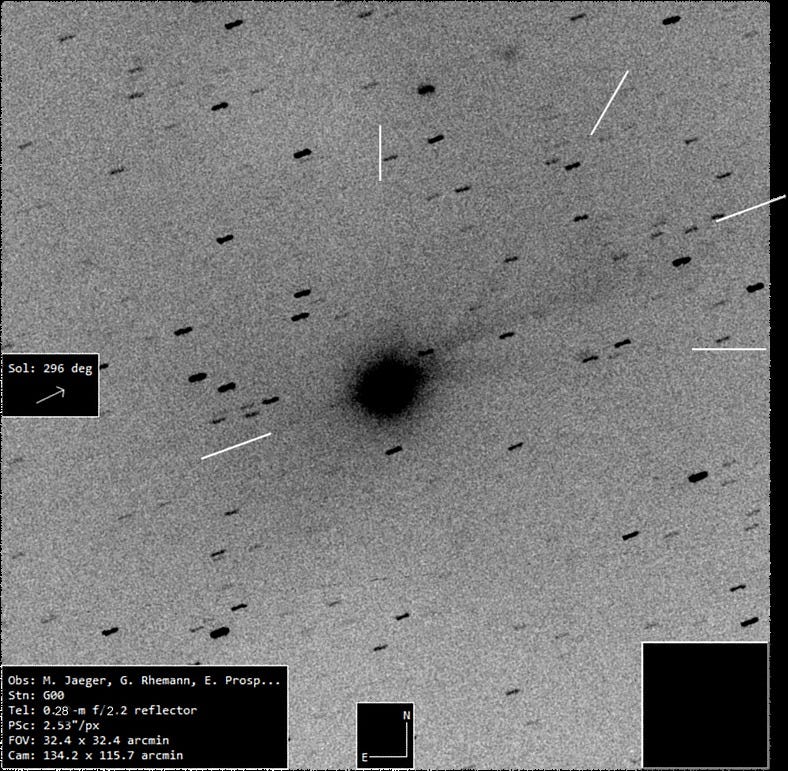
You can see this pretty clearly in these images, where the short anti-tail is clearly red due to dust (in this particular color scheme):

Things get even clearer in the color image mastodon.social/@coreyspowel… – coma green, plasma tail blue, stubby dust (anti)tail red. So what questions does this textbook comet leave open?

(@cosmos4u.bsky.social) 2025-11-17T04:57:12.541Z

So Loeb’s outgassing calculation is totally wrong, which makes the rest of the reasoning fall apart.

Here’s the thing: if Loeb had worked with any sort of comet expert they could have pointed this huge error out to him. I’ll also point out that 3I/ATLAS’s tail is pretty ordinary for a comet, so this isn’t an “anomaly” at all (unless lots of comets are spaceships?)  It’s just a misunderstanding by Loeb.

Loeb’s 3I/ATLAS “Anomalies” Explained

Avi Loeb continues to claim that 3I/ATLAS has many anomalous behaviors that lead to the conclusion that it “might” be an alien spacecraft.  He carefully hedges the probability that it is a spacecraft around 40%, which gives him plausible deniability of the bad-faith “just asking questions” variety while still making the comet sound weird enough that lots of people are thinking (or worried!) that it’s an alien spacecraft. It certainly gets him lots of TV time and fan mail.

Here are why these anomalies are not indications that it is an alien spacecraft.

It’s Obviously A Comet

Loeb has apparently repudiated his original argument about the Duck Test for 3I/ATLAS. He first argued that if it acted like a comet as it approached the sun by growing a coma and tail and exhibiting cometary features that that would mean it’s a comet. When evidence for a coma emerged he first dismissed it as being poor observational technique, and then when the same conclusion was reached with Hubble Space Telescope data he called it “model dependent.”

Then once the coma (and tail) became inarguable he switched gears and said that a spacecraft should have those things after all!  He has now explicitly written that no matter how much it walks like a duck, quacks like a duck, and swims like a duck, he will find ways to insist it’s at least 20% likely to be an alien spacecraft.

But look: it has a tail and coma like a comet. The tail and coma have the gases we expect to see from a comet. It’s brightening and evolving as it warms up like comets do. If Avi had not claimed it could be an alien spacecraft no one would be talking about it as anything but a comet.

It’s also worth noting that zero planetary scientists give Avi’s claims any credence. Contrary to his complaints, this is not because they are afraid to consider the aliens hypothesis or they are stuck in their ways (after all, I’m the director of the PSETI Center where we try to push the boundaries of the search for aliens!). I have found planetary scientists to be very open minded about this!

They’re saying he’s wrong because he’s demonstrably wrong.

Anyway, keep in mind that for every way 3I/ATLAS is acting “anomalous,” there are at least a dozen ways that it’s acting exactly like a comet, and not like an alien spacecraft.

Lots of Comets Are “Anomalous”!

The first thing to understand about comets is that no two seem quite alike. Planetary scientists have an expression “Comets are like cats: they have tails, and they do precisely what they want,”* meaning that they don’t obey any consistent rule of behavior except that they all have tails—and even having tails is now known to not be a rule!  Indeed, this is why Karen Meech named tail-less comets “manx” comets (we now also know of “dark comets” which have neither tails nor comae!)

So when someone says a comet is “anomalous” planetary scientists yawn: what else is new? Indeed, when I was on the committee allocating time for national telescopes to observe targets we’d always get some proposals to observe comets, and each one was about how unique and special this new comet in the solar system was, necessitating new observations. By year three I had caught on: every bright comet was weird in some new way worthy of study.

So the question isn’t whether 3I/ATLAS is anomalous: it’s from another Solar System, so of course it’s anomalous! It’s whether it’s so anomalous that there’s any reason to think it’s anything other than a comet.

Consider the Track Record of the Messenger

The second thing you need to understand about Loeb is that he has no training in planetary science (the study of comets and other things in the Solar System) and does not seem to consult planetary scientists before (or after) making his claims. Yes, he is an accomplished astrophysicist, but his area of expertise and success is very far from the study of comets, with almost zero overlap.

Yes, he has published many papers on comets, but none of his co-authors have any expertise in these matters either, and most of those papers are not peer-reviewed, so they have not been checked for accuracy.

In these papers and on his blog he regularly betrays an unfamiliarity with well-established planetary science concepts and misinterprets papers and comes to erroneous conclusions. When the authors of those papers complain he has misstated or even reversed the meaning of their conclusions or when his errors are otherwise pointed out, he either keeps repeating the misinformation, or quietly drops the line as if nothing happened. I’m not aware of him ever admitting he got something wrong with respect to 3I/ATLAS and retracting a claim, despite ample opportunities to do so.

Science is very forgiving of incorrect hypotheses—indeed it’s essential to the whole enterprise! But good scientists are supposed to acknowledge when a hypothesis is no longer supported and move on—it’s part of the humility that makes science work.

It’s also true that I am not a planetary scientist! But I do have experience with observations of Solar System objects and my work in exoplanets gives me a lot of familiarity with planetary science concepts. More importantly, I have consulted on this post with planetary scientists like Steven Desch, Michael Busch, Qicheng Zhang, and Marshall Eubanks who are experts on these things.  I also do my best to own up to my mistakes and correct the record. I think these things give me more credibility about 3I/ATLAS than Avi.

[Disclaimer: while I’ve consulted with these experts, everything I’ve written is my own, which means any mistakes are on me, not them.]

We Expect 3I/ATLAS to be Anomalous

We do!  This is only the 3rd interstellar comet we’ve seen, and it’s bound to behave differently from Solar System comets for two big reasons and two little ones.

A minor reason is that unlike comets in the Oort cloud (which are so far from the Sun they experience the radiation of interstellar space for basically their whole lifetimes), 3I/ATLAS has taken a different route through the Galaxy than the Oort cloud, so has suffered different effects of radiation.

A second minor reason is that 3I/ATLAS may have spent much more or less time in interstellar space than Oort cloud comets, which have been there for the age of our solar system while 3I/ATLAS will be of a different age, and so have had a different amount of time to be altered by interstellar space.

The first big reason it should be different is that it’s from a different Solar System so might have a very different composition and history close to its star than our comets did when they formed.

But the biggest reason is that it is moving much faster towards the Sun than any Oort cloud comet (or than 2I/Borisov of 1I/’Oumuamua did) so at a given distance from the sun it’s had much less time to heat up the way comets do. This will certainly cause it to evolve differently from other comets!

Loeb’s List of 10 Anomalies

So let’s break down the anomalies he keeps repeating, so we can see why there’s nothing to worry about with 3I/ATLAS (this list is verbatim from four days ago):

1. Its retrograde trajectory is aligned to within 5 degrees with the ecliptic plane of the planets around the Sun, with a likelihood of 0.2% (see here).

To paraphrase Einstein, his math is fine, but his statistics are atrocious.  The best takedowns of this argument I know are by Hector Socas-Navarro. Basically, if someone had predicted ahead of time what the properties of a spacecraft would be like and it matched them then they’d be on to something. But Loeb chose specific aspects of the comet’s orbit to compute probabilities for after he knew what they were. That’s a classic fallacy and misuse of probability theory.

2. During July and August 2025, it displayed a sunward jet (anti-tail) that is not an optical illusion from geometric perspective, unlike familiar comets (see here).

It’s true that not many comets do this but it’s hardly unique. He also falsely claims he’s the first to explain why this might happen naturally, when in fact this has been understood for 50 years.

3. Its nucleus is about a million times more massive than 1I/`Oumuamua and a thousand times more massive than 2I/Borisov, while moving faster than both, altogether with a likelihood of less than 0.1% (see here and here).

This is simply incorrect. His assertion here is based on an erroneous calculation that the measurement of 3I/ATLAS’s nongravitational acceleration before perhelion could be measured to a precision of 10-10 AU/day2, when the actual precision is more like 10-7 AU/day2 (a thousand times larger).

This is especially frustrating because he regularly now cites papers quoting the correct number without critique, not acknowledging it contradicts his other claims. (In other words, his anomaly #10 below comes from data whose precision contradicts his calculation in anomaly #3—he can’t have it both ways!)

4. Its arrival time was fine-tuned to bring it within tens of millions of kilometers from Mars, Venus and Jupiter and be unobservable from Earth at perihelion, with a likelihood of 0.005% (see here).

Claiming the arrival was “fine tuned” is classic question begging. This is the same bad statistics from “anomaly” number 1, and Steve Desch has pointed out there is hardly anything surprising about a comet in the ecliptic passing by some of the planets.  Loeb also calls it anomalous that it gets “close” (not that close really) to some planets, but also anomalous that it is not that close to others.  Close, not close, both anomalous! With logic like this, every comet could be said to be anomalous.

5. Its gas plume contains much more nickel than iron (as found in industrially-produced nickel alloys) and a nickel to cyanide ratio that is orders of magnitude larger than that of all known comets, including 2I/Borisov, with a likelihood below 1%.

This is a genuine anomaly in the sense that it’s an extreme value! But it’s also something very consistent with what we know about comets. There’s no “standard” Fe/Ni ratio or nickel to cyanide ratio in comets, they vary by a lot.  We are seeing nickel in 3I/ATLAS at a much larger distance from the sun than we normally look for it, and some pretty standard chemistry can explain why it will have a large anomaly out there. We expect it to come more in line with Solar System comets as it heats up.

So this is hardly so weird that planetary scientists are baffled. There’s interesting chemistry going on here but nothing suggesting the thing is nickel plated.

6. Its gas plume contains only 4% water by mass, a primary constituent of familiar comets (see here).

Yup! That’s weird. Not unheard of for comets though.  3I/ATLAS is outgassing all of the normal comet things to outgas (H2O, CO2, CO) just in a different ratio than we typically see, though not outside the boundaries of all comets. The fact that it’s outgassing these things at all strongly says “it’s a comet”.

Some comets are weird, and we expect this one to be weird.

7. It shows extreme negative polarization, unprecedented for all known comets, including 2I/Borisov, with a likelihood below 1% (see here).

Yup!  That’s weird. It’s normal for comets and asteroids to show negative polarizaion, but it’s a bit stronger than we’ve ever seen before. Again, this is a very “comet” thing for 3I/ATLAS to do, it’s just more extreme than we’ve seen.

I don’t know why the grime evaporating off of an alien spaceship would be expected to have extreme negative polarization, though, so while it’s certainly an anomaly it’s not evidence for a spaceship!

8. It arrived from a direction coincident with the radio “Wow! Signal” to within 9 degrees, with a likelihood of 0.6% (see here).

This is ridiculous. 9 degrees from the Wow! Signal is a long way away! In other words it very definitely did not come from the direction of the Wow! Signal.

Also, for what it’s worth, it’s not as if we know aliens are out there in the direction of the Wow! Signal. The Wow! Signal failed the sky localization test when it was discovered, and I think most SETI practitioners believe it was some sort of instrumental glitch.

9. Near perihelion, it brightened faster than any known comet and was bluer than the Sun (see here).

Yup! This is an interesting anomaly. It did brighten very quickly for a comet. But, again: we expect it to brighten unusually because it’s coming in unusually fast (although this calculation tries to correct for that fact). Also: there’s no reason to think a spaceship would brighten quickly!

Also “bluer than the sun” is a weird way to express an anomaly. The light it’s reflecting depends on the composition of its gaseous coma.  In this sense, lots of comets are “bluer than the Sun.” That’s not really anomalous.

10. It exhibits non-gravitational acceleration which requires massive evaporation of at least 13% of its mass (as calculated here), but preliminary post-perihelion images do not show evidence for it so far.

This is the one that will generate the most discussion among planetary scientists. The idea is that if it moves due to forces other than gravity by a lot compared to what we expect from comet outgassing, this could implicate thrusters, or if it moves too little (Loeb’s earlier argument) this would implicate a very high mass (too high to be from a population of interstellar objects moving around randomly, indicating it was directed here).

First of all, the non-grav acceleration of 3I/ATLAS is not well measured because the uncertainties probably don’t properly account for the fact that it’s hard to tell a precise position for a fuzzy comet. Lots of planetary scientists are skeptical of the statistical significance of the detection Avi’s hanging his hat on here.  The true NGA is probably much smaller than this.

But even if it is correctly measured and his math here is correct (which is dubious, but I don’t have time for that here): losing 13% of its mass is hardly weird! It’s just would you would expect, in fact. Comets are made of ice, and lots of that ice will get lost when it comes near the sun!

And as for “post-perhelion images show[ing] evidence for it,” that’s just not a thing? When gases and dust move away from a comet they quickly become so rare (un-dense) that they are unobservable.

Loeb seems to be setting up a false argument that if we can’t account for all of the ejected mass of the comet in images of its tail and coma, then it can’t be a comet and must have thrusters. This argument would be very wrong. Lots of comets show thrust with no detectable tails!

Summary of Anomalies

So of Loeb’s 10 anomalies, only 4 really have planetary scientists interested: the high nickel abundance, the extreme polarization, the strange water abundance, and the rapid brightening. All of these are the sorts of anomalies one expects from a new kind of comet. They weren’t exactly predicted ahead of time as far as I know, but neither did Avi predict (or even “post-dict”!) that there was some reason that an alien spacecraft would show them.

None of them are evidence it’s a spacecraft! There’s no reason spacecraft would do these things. There are lots of reasons comets from another solar system would.

Other Features

Above, I list Loeb’s “anomalies” as of early November. Knowing him, he’ll likely find others as we learn more about the comet to add to his list.  I’ll try to keep those up to date below.

One is that 3I/ATLAS is showing some fantastic jets of material now:

So before Loeb can claim this is an anomaly, know that this is a thing comets do.  It’s also not something I think anyone would expect a spacecraft to do?

Comet 17P/Holmes
Comet 17P/Holmes

C/2016 R2 (PanSTARRS)

C/1961 R1 (Humason)
C/1961 R1 (Humason)

[Update 14 Nov 2025] …and sure enough Loeb has a new anomaly. He claims that the length of the tail is inconsistent with 3I/ATLAS being in one piece, and since it is in one piece it can’t be a comet. This is wrong, as explained here:

Avi Loeb's calculations about 3I/ATLAS are 100% wrong because he has never understood that dust in the tail(s) responds to solar radiation pressure. Solar wind shapes the ion tail. But the radiation pressure is about 1000 times larger than the solar wind ram pressure, for particles that feel it.

Steve Desch (@deschscoveries.bsky.social) 2025-11-13T21:36:44.964Z

Addendum: Some Responses to Critiques of this Piece

Above, I provide some links for detailed breakdowns of why some of the anomalies are anomalies, but in some cases I’m just asserting what planetary scientists understand about comets. This is definitely an appeal to authority, but it’s a pretty good authority!

My purpose here isn’t to write a refereed scientific paper rebutting his work (I don’t have time to do that, but also until his claims make it into the refereed literature it’s not really worthwhile to rebut them there). It’s also not to do a point-by-point rebuttal with data of everything Loeb claims. That would be a huge post and link to lots of primary literature in the planetary science corpus. We’d need to go into decades of research into comets and chemistry and all the rest. Steve Desch has done some of this but Loeb writes new claims so quickly it’s really hard to keep up

This is a popular science blog post, not intended to convince every skeptic and Loeb fan (how could I?), but simply to separate fact from fiction around this comet.

Also, after writing this lots of readers accused me of being obviously biased against Loeb. I guess that they just can’t imagine that his behavior is as bad as I write, and so I must be exaggerating things because I dislike him.

This isn’t so! I actually worked with him and for years we enjoyed encouraging each other in the SETI space. I thought his early work on ‘Oumuamua was an important way to get the conversation of Solar System SETI started, and I was one his few defenders as he gained notoriety for pushing this line of reasoning. You can read my early posts on him if you don’t believe me.

Critics of this piece also argue that I should be more dispassionate and address only his arguments, and not his behavior. But it’s actually his behavior that’s the problem, not his arguments! If people want to make bad arguments about aliens that’s fine—I don’t go around debunking them all. The problem is that he is deploying the trappings of scientific authority to misinform the public and steal the attention of the science-interested public from the hard work planetary scientists are doing on this amazing object. I continue to get calls from reporters at mainstream news organizations asking me to be a counterpoint to Avi about his alien claims, as if the right answer lies somewhere between our positions, and as if either one of us is a comet expert! (I beg them to not quote either of us and interview planetary scientists instead).

I actually find Avi’s openmindedness and willing to explore the aliens hypothesis quite laudable! It’s not his question asking that’s the problem, it’s his very public dismissal of expertise, demonization of his critics, and misleading the public that I have issue with, so I have to talk about him and his behavior, not just his claims.

*I updated this quote to match what I’ve found on Google, which attributes it to David Levy.

Wait…Maybe a 15 year Dyson Sphere Isn’t *Literally* Impossible?

In my previous post I argued it’s literally impossible to get the mass you need from Jupiter to build a Dyson Sphere.

Thinking about this more, and following up on a thread I dangled in my podcast interniew, I think there might be a way to wriggle out of my argument!

The reason is that there’s another source of mass you could use—Venus—and that plus the exponential growth available via von Neumann machines means maybe—just maybe—the laws of conservation of energy might not limit you.

Let’s say you had already, somehow, set up self-replicating machines on Venus that could take energy and use it to mine material to make more of themselves, solar panels, and somehow launch the solar panels into space.  It’s the launching that’s probably most energy intensive so let’s just assume all of the power they get from the solar panels they generate goes back into that.

Solar panels at the distance of Venus from the Sun collect 2×10⁶ erg/cm2/s, and the cost of lifting mass from the surface is 5×10¹¹ erg/g. Typical solar panels have surface density if 15 g/cm2. Putting these together, and given that Venus is probably around 25% silicon, one can compute a characteristic timescale to generate enough energy to launch enough material to double the area of solar panels (in the continuous limit, an e-folding) of about 0.35 year.

That’s an interestingly small number! It means you get 3 e-foldings in a year, which is a factor of 20 every year. If we start with a solar array with just 1 m2, in 1 year we will have 20 m2. To build a 10% coverage Dyson Sphere at this distance we need 1022m2  which means 53 e-foldings which is just 19 years! Faster actually, because Venus is losing gravity as it goes.

Do we have enough mass in Venus for this? The mass of this sphere is 2×1027g, and the mass of Venus is 5×1027g, and Venus is presumably 25% silicon so actually it’s pretty close!

There is also a lot of energy in the planet’s mass energy itself—more than enough if it’s using fusion to fuse material into iron, so it could in principle go even faster.

Now, this emphatically does not mean we can build a Dyson sphere out of Venus in just a few years! It means that the thing preventing it is not a lack of energy once you get started—you can, in principle collect enough sunlight to do this in <20 years, maybe 15.

But the broader point is that this is just one of the many issues with building a Dyson sphere that go unaddressed with Sam Altman or whoever blithely says we’ll build one in our lifetimes. There are a whole host of problems that will come up, many of which will be showstoppers.

Will We Build a Dyson Sphere in 15 years?

Yes, Betteridge’s Law applies here!

I did a fun podcast interview here with Prakash Narayanan (@8teAPi) about Dyson Spheres:

The framing is that some commentators had suggested humanity might build a Dyson sphere at some point in our lives.  I pointed out this is impossible!

Some people in the comments wondered about my math, so here it is:

Most of these people are imagining we’ll capture something like 10% of the Sun’s energy, or more, using solar panels. For concreteness, and since this is supposed to happen as soon as we hit the singularity in 10 years or something, let’s assume for now the Dyson sphere’s primary mass requirement is its solar panels / radiators, not the computers or whatever is being powered by the sun.

Today, solar panels are composed of about 50% silicon, so we’ll assume that’s the limiting reagent. They have surface densities of around 15 g/cm2, so we just need to know their area to determine their total mass and total mass in silicon.

Let’s say that there’s a swarm of collectors covering 10% of the output of the sun operating near 1 au, so their typical temperatures are high (around the boiling point of water) but not outrageous.

In this case the area of all of the collectors is 10% of 4π(au)2/10, which works out to 3×10²² m2. So their total mass is 4×1024 kg (which is about the 70% the mass of the Earth), and requires 0.3 times the mass of the Earth in silicon.

Now comes the first problem: Jupiter only contains about 1 Earth mass of silicon! You’ll need to mine the entire planet Jupiter to get enough silicon for a Dyson sphere with just 10% coverage.

No problem, you say, AGI will show us how to build solar panels out of other materials. Let’s assume this is true and you can use all of the elements in Jupiter for this except hydrogen (which is a small fraction of the mass of most things) and helium (which does not form compounds).  Now you have 18 Earth masses of material to work with.  You could build an even bigger Dyson sphere!  Or maybe you only need to mine 5% of Jupiter.

Not so fast. All that mass you need is deep down inside of Jupiter’s gravity well.  You have to give it a big delta v to get it out where you can use it, and this requires energy.

As I discuss in the podcast, this is not just an engineering problem that an AGI might be able to solve. It’s a physics problem that no clever engineering can overcome: you need a lot of energy to get that mass out of Jupiter’s gravity well, and the only source in the solar system with anywhere near enough is the Sun itself.

The energy required to unbind Jupiter’s mass is roughly fGM2/R where f is a factor of order unity that measures its central concentration and the amount of internal energy it has. I don’t know this number for Jupiter, but I’ll generously WAG that it’s around 0.25 (this detail does not matter). This works out to around 1043 erg.  To get just the top 5% of the mass it’s more like 1042 erg.

The sun produces 1033 erg/s, which means even if you had already built a Dyson Sphere collecting all of the sun’s output, it would take 70 years to put that energy into lifting the required mass off of Jupiter. This is where my 100 years number in the podcast comes from. To get just the top 5% takes you 7 years.

OK, 7 years, what’s the problem?

The problem is we don’t already have a Dyson Sphere, so it must take much longer than that. It’s a chicken and egg problem that you need a Dyson Sphere to build a Dyson Sphere quickly.

Putting things a bit closer to the Sun or doing “only” 1% of the Sun’s output or making the Solar panels thinner and less massive might buy you a factor of 10-1000, but it’s not going to bridge the gap of about 1018 between the power we can collect in space now and what we need to collect to start disassembling Jupiter.  Fusing Jupiter’s hydrogen into silicon buys you a tiny bit of power back and gives you more mass to work with but that’s only a factor of 10-100.

So you see, the engineering doesn’t matter. A Dyson Sphere like they described is literally impossible to build in our lifetime, or probably any time in the near future.

Which is good because it’s a terrible idea if we care about the Earth’s biosphere at all! Unless the sphere somehow carefully managed its outgoing radiation, it would warm the Earth in a way that makes current climate change look trivial (the details depend sensitively on the parameters of the sphere).

[Update: Important update! Maybe it’s not literally impossible?!]

No, Loeb Has Not Shown the Size of 3I/ATLAS to be around 5 km

So, in a preprint and in many blog posts, Loeb is claiming that he and others have estimated the mass of 3I/ATLAS from the lack of any measured non-gravitational acceleration.  He keeps repeating that it is “a thousand times more massive than 2I/Borosov”.

This is not correct.

He’s making a lot of errors in the calculation. In his calculation, he works out the difference between the trajectory of a comet unaffected by nongravitational accelerations and one that is affected by an acceleration a.  Since acceleration changes the position of an object as a quadratic function of time, we should see the comet deviate from a purely Keplerian orbit in a way that grows as at2/2.

He then calculates the force F of the jets on ATLAS, puts an upper limit on the deviation in time we’ve been monitoring it (turning an upper limit on the deviation into an upper limit on the acceleration a), and uses this to constrain the mass via F=ma.

Now the first of all this is very rough. The acceleration from jets grows with time, it changes direction with time, it is not all in one direction, and our measurements are not of its one-dimensional position in the direction of the acceleration but of two out of three positions of its orbit in space divided by its ever changing distance from Earth.  These are all big complications, and not all “of order unity” in a way that won’t matter much for his calculation.  In particular, his calculation implies all of the thrust from outgassing is in one direction which is definitely wrong.  [Update: Marshall Eubanks below points out that these and issues similar to the one I describe below add up to an error by Loeb by a factor of 1000–10,000.]

But even assuming those things don’t matter (which they do!), he’s still making another (easy to fix) error that changes the answer.  The problem is that we don’t know the unperturbed orbit of 3I/ATLAS. We only measure the perturbed orbit (if it is perturbed) and we fit this orbit with a model that assumes no perturbations. So yes, if there are perturbations the model will not fit, but importantly: any perturbations from jets will be partially absorbed into the fit and make them less noticeable.

To correct his (very rough, unreliable) calculation for this error (making it perhaps more accurate but no more precise) we have to calculate the deviation from the fit not as at2/2 but as at2/12 (this is the maximum residual of a linear fit to his quadratic function spanning time t).

So you also have to divide the mass he gets by 6, making his estimate more like 150 times the (presumed) mass of 2I/Borosov, and making his calculation of its diameter more like 2 km, (and so consistent with the HST measurements).

The calculation Loeb performed, showing a quadratic deviation (blue) from an unperturbed orbit (orange).

A better calculation, showing the quadratic deviation (blue) from the best-fit to the data (orange). Because it’s a best fit, it minimizes the differences and makes the maximum deviation smaller by a factor of 6.

Now, I imagine Loeb would respond that this is still very anomalous!  But that would miss my points which are:

  1. People know how to estimate the nongravitational accelerations of comets, and this isn’t it.
  2. His calculation ignores lots of physics we know matters that will change the answer, mostly downwards.
  3. His calculation is sloppy, getting a number 6x too high even by its own erroneous logic.

Anyway, Loeb is using his (6x too large and wrong anyway) lower limit of mass he claims to have calculated on 3I/ATLAS as one of the “anomalies” that justify him never giving it a probability less than 20% on being an alien spacecraft, no matter what future observations reveal.

I’m not exaggerating. No matter how well it passes his own Duck Test and behaves like a comet, he’ll never be convinced. Read for yourself:

If, as a result of the intense solar heating, 3I/ATLAS will show all the features of a natural comet, I will reduce its rank to 2 on the Loeb scale (quantified here and here). The rank will not go down to 0 because the enormously larger mass of 3I/ATLAS relative to 1I/`Oumuamua and 2I/Borisov and its fine-tuned orbital alignment with the ecliptic plane, will never go away.

(He has repeatedly multiplied the numbers on the “Loeb Scale” by 10% to estimate the chances it’s an alien spacecraft which is by itself all kinds of wrong, but there you have it.)

Other entries here.

[Update: I have actually tried to reproduce the numbers in their paper but I can’t.  Following their logic and numbers, I get aNG = 7×10⁻⁸ cm/s2, not 2×10⁻⁷ as they do.  This leads to a mass of 1017 g, not 3.3×10¹⁶ g.  This actually makes their calculation for the mass higher.  But they still are missing the factor of 6, so by their logic and correcting their math, the mass upper limit should be 1.5×10¹⁶ g, a factor of 2 smaller than they quote.]

[Update: I’m promoting Marshall Eubanks’s comment to the main post here:

This is embarrassingly bad. To estimate parameters you include them in the fit, not look at the residuals. (That takes into account the masking and correlations between parameters) I (and I am sure many others) have been doing these sorts of fits since July. Using the full data set up to 3I/ATLAS’s superior conjunction (it is very near the Sun right now, and so terrestrial data has stopped) I get

Orbital elements: 3I
Perihelion 2025 Oct 29.47657 +/- 0.0025 TT = 11:26:15 (JD 2460977.97657)
A1: (8.25 +/- 1.97)e-7
A2: (14.73 +/- 5.54)e-7
A3: (-0.46 +/- 3.71)e-8 AU/day^2
3742 of 4131 observations 2025 May 8-Oct. 5; mean residual 0″.59

A1, A2 and A3 are the “Comet” non-gravs (which assume jets with temperature dependent strength) I also use the solar radiation non-gravs and get similar formal errors; I don’t get anything really significant with any of the possible subsets of parameters either.

Note that the formal error here is considerably worse (3 – 4 orders of magnitude!) than the 10^-10 AU/day^2 the linked paper is claiming, even though I have more data. I am sure the difference is due to totally ignoring the correlations with the orbital parameters (which range up to 0.543594 in this Comet-non-grav solution).

The basic idea to use measured non-gravs to estimate the 3I mass is not without merit, and was discussed briefly in our paper on potential  3I spacecraft observations.
https://arxiv.org/abs/2508.15768.

However, no celestial dynamacist would accept their residual analysis as being conclusive, they can’t claim a limit of 10^-10 AU/day^2, 10^-6 AU/day^2 is more realistic for these parameters, and that makes their argument irrelevant, at least for the time being.

I am hopeful we can get the non-grav formal errors down to 10^-10 AU/day^2 before we are done with 3I/ATLAS, but i think that will take some successful occultation measurements from Earth, and so far the attempts to detect 3I/ATLAS occultations have been unsuccessful. (The upcoming spacecraft angular position of 3I from Psyche, Juice and MRO will help, but I fear won’t be enough for this.)

]

3I/ATLAS’s Anti-Tail Isn’t Unique

So, Avi’s latest is a long complaint about how unreasonable the scientific community is in dismissing his claims that 3I/ATLAS might be a spacecraft. He has a long analogy in it about seeing a bizarre creature walking down the road and having everyone try to gaslight you by saying it’s just a cat:

Imagine noticing a new animal in your backyard with a tail coming out of its forehead instead of its rear end. After looking at its image, experts argue that it must be a cat because cats have a tail. You point out that cats do not have an anti-tail but the experts dismiss the anomaly and keep telling reporters that any street animal with a tail must be a cat. You also calculate that the animal is at least a thousand times more massive than the only street cat that was previously identified in your backyard, but experts dismiss the anomaly and argue that some cats might be much bigger than others.

It goes on like this for a while.  It’s all very silly, and there’s even complaint about how the editor of the Research Notes of the American Astronomical Society won’t take his papers without edits anymore (is it any wonder?).

These two particular claims—a cat with a tail on its forehead and that is supermassive—are based on his latest “anomalies” for 3I/ATLAS.  Remember, originally the anomaly was that it didn’t have a coma or tail and so was HUGE for a comet, and when the coma was finally carefully measured he insisted it was just poor observational technique. When he finally admitted the coma was real, he suddenly realized that spacecraft should have comae after all because it’s part of a collision early warning system.

When he realized how silly that was, he switched to adopting the line Steve Desch mocked him with and decided the coma was from dust from its long interstellar voyage.

The then claimed that he had shown that most of the light was coming from the lights on the spacecraft itself, but he dropped that line pretty quickly, replacing it with this insistence that he and a colleague had done a calculation that showed that the comet experts using HST had done it all wrong and the comet was much bigger than experts claimed.  Annoyingly, he keeps referencing the same paper as independent confirmation of this latest claim:

The diameter of the nucleus of 3I/ATLAS has an upper limit of 46 kilometers (as derived here),

The problem is that the link is to a paper that explicitly says that the 46 km number is just a reference point for the size of a comet of the same brightness with no coma, and explicitly cites a smaller upper limit of around 5 km. I know that Casey Lisse, the first author of that paper, is pretty annoyed by Avi misrepresenting his work like this.

Anyway, lately Avi has two new calculations he’s done.  One tries to estimate the mass of 3I/ATLAS from the lack of measured gravitational acceleration in its path from its outgassing.  This is a good idea!  He doesn’t cite any of us that are actually working on this, but whatever.

The problem is that the analysis is really naive.  It’s not necessarily wrong, but it’s at best an order-of-magnitude calculation. The tools exist to do this calculation really well, but he neither uses nor acknowledges them. Sigh.

The other angle is his really bizarre claim that the cat has a tail coming out of its forehead. Here’s his paper on this with Eric Keto on the apparently sunward-facing tail of 3/ATLAS seen with Hubble:

This phenomenon, observed at a distance of 3.8 au from the Sun, is not common and possibly observed for the first time in 3I/ATLAS.

And in his blog he says this paper is “the only paper in the literature providing a physical explanation for the anti-tail.”

So, for those wondering what’s really going on:

First of all, it’s obviously a comet. Just look at it. But in detail, and secondly:

If these things were so weird in comets that they couldn’t be explained by comet physics, why does his paper with Eric Keto explain things entirely with ordinary comet physics?

Thirdly, why does he claim on his blog that his calculations with Keto show that the Jewett et al. conclusion from the HST images that the object is small is actually ambiguous and highly model-dependent, while his actual paper on the topic with Keto on the topic says nothing of the sort?

But finally, anti-tails are not as weird as a cat’s tail coming from an animal’s head. A quick search on ADS reveals a well cited paper by Z. Sekanina in 1974 literally entitled “On the Nature of the Anti-Tail of Comet Kohoutek (1973f) I.: A Working Model.”  It is everything Keto and Loeb claim they were the first to explain.  The paper opens:

Dynamical and geometrical considerations determining the general visibility conditions for the anomalous Sun-oriented cometary tails have been discussed elsewhere (Sekanina, 1974). Their application to Comet Kohoutek (1973f) allowed the prediction that for a couple of days around January 1, 1974, the comet could display an anti-tail, composed of relatively heavy particles from preperihelion emissions (Sekanina, 1973a).

Talking to experts on BlueSky, it turns out there are two kinds of anti-tails.  One is just an optical illusion: a tail that trails the comet can appear to look like it’s pointed at the sun from our perspective. Wikipedia has a nice description of this including a great picture of a comet with one of these from 2024. As Avi (correctly) notes, that’s not what is going on with 3I/ATLAS.


But there’s another kind of anti-tail, too, formed when large dust grains are ejected that don’t get swept up by the solar wind on the sun-facing side of a comet. Contrary to Loeb’s claims, this has been seen in other comets before, and even discussed explicitly in the context of 3I/ATLAS, for instance in this paper that states:

While such a morphology is certainly unusual—given that dust tails are typically directed antisolar due to radiation pressure acting on dust grains—it is not without precedent among distant active bodies. Notably, Farnham et al. (2021) reported a similar sunward enhancement in comet C/2014 UN271 (Bernardinelli–Bernstein), which they interpreted as the result of the slow ejection of relatively large dust particles predominantly from the sunlit hemisphere.

And they go on to discuss the physics. So… not unique, and Keto and Loeb are the not to describe it or explain it.

I’ll add that even if the Keto and Loeb analyses were novel and interesting contributions to our understanding of how to measure astrometric masses of comets and explain anti-tails, it’s lazy and unprofessional to try to re-derive all of this yourself from scratch with rough calculations and totally ignore the literal decades of work already done on the topic, and then expect those experts familiar with the state of the art to take you seriously.

Think about it. Take something you understand really well because you’ve spent a lot of time studying it or working with it. Now imagine that a self-proclaimed expert with zero experience in that starts going on national television saying they’re the first to tackle the problem and they’ve figured out how it all works. Even if their analysis were correct, you would still tell people not to take them seriously, right?

Indeed, his whole post is like the Platonic Ideal of the Galileo Gambit (any wonder he keeps comparing himself to Galileo and calls his UFO project the Galileo Project?).

I encourage people still entertaining Avi’s posts to consider all the times he’s dropped arguments because they turned out to be wrong without ever admitting error. Science is self-correcting because scientists are supposed to have the intellectual humility to admit when their hypotheses were wrong and accept the path of evidence.

When Avi starts admitting his errors, listening to experts, citing and engaging with their work, and building on their knowledge instead of ignoring it or dismissing it because it doesn’t comport with his aliens hype, then you might want to give him the benefit of his credentials and listen to what he’s saying.

Until then: 3I/ATLAS is very cool! But it’s clearly a comet, not an alien spaceship.

Other entries here.


This Isn’t An Argument, It’s Just Contradiction

There’s a classic Monty Python skit in which someone goes into an “argument clinic” and pays for an argument and gets frustrated at the manner of argument he ends up in.

Key dialog:

I came in here for a good argument
No, you didn’t. You came in here for an argument
Well, argument isn’t the same as contradiction
Can be
No, it can’t!
An argument is a collective series of statements to establish a definite proposition
No, it isn’t
Yes, it is. It isn’t just contradiction
Look, if I argue with you. I must take a up contrary position
But it isn’t just saying “No, it isn’t”
Yes, it is
No, it isn’t. Argument’s an intellectual process. Contradiction is just the automatic gainsaying of anything the other person says
No, it isn’t

Anyway, that popped into my head when Avi Loeb finally addressed the conclusive observations by HST that 3I/ATLAS has a small (r<3 km) nucleus:

The flux detected by the SPHEREx space observatory at a wavelength of 1 micrometer from 3I/ATLAS on August 8–12, 2025 suggests a huge nucleus or alternatively an opaque dust cloud that scatters sunlight with a diameter of 46 kilometers (as reported here). The limited resolution of the Hubble Space Telescope image does not provide a robust constraint on the fraction of sunlight reflected by the nucleus relative to a surrounding dust cloud. The theoretical inference drawn from the data (accessible here) is highly model-dependent and does not resolve the existing uncertainty about the size of 3I/ATLAS.

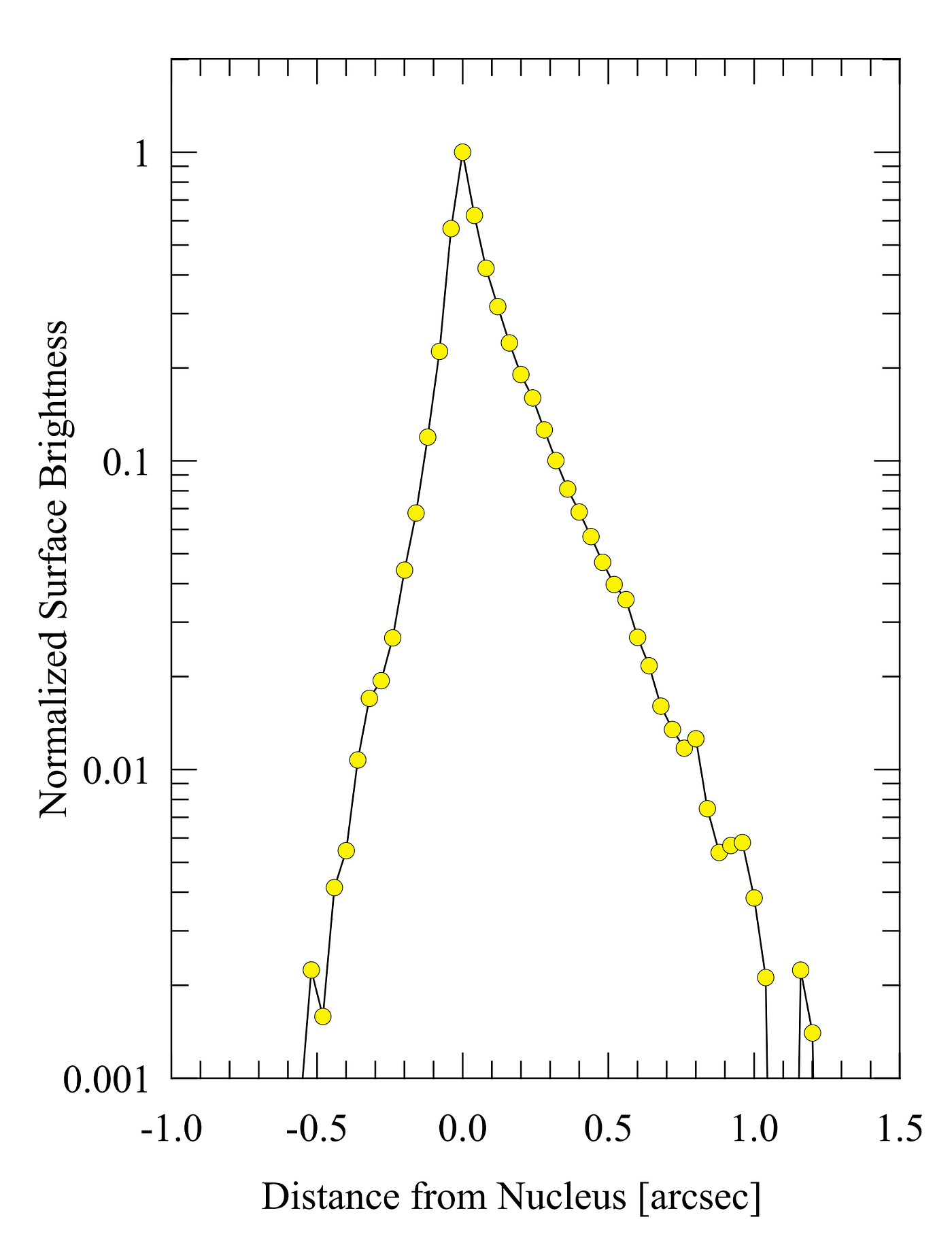
So the entirety of his argument that it could still be a spacecraft despite having a clearly cometary coma is his ipse dixit that the HST results are “theoretical inferences” that are “highly model-dependent.”  (They aren’t—you can see pretty clearly even by eye that the surface brightness profile is dominated by a broad coma and not a central nucleus because it follows a power law slope of -1, and does not follow the profile of a star.  The detailed analysis in that paper confirms this.).

He also wants to be sure that we know that someone on Twitter thinks he should get the Nobel Prize:

 The nature of 3I/ATLAS will be decided by better data and not the number of likes or premature Nobel Prize promises on social media.

How noble and humble of him to so publicly refuse the crown like that!

Other posts here.

[Update: Loeb, with Eric Keto as lead author, has put a manuscript on the arXiv detailing their analysis of the HST images. This paper contains no mention of 3I/ATLAS as anything other than an ordinary comet and, even more interestingly, makes no mention of Loeb’s claims that the Jewitt et al. upper limit on the size of the nucleus is “model dependent.”  Apparently Keto, who seems to have done the analysis, does not share that assessment of Loeb’s?]

HST Has Conclusively Shown that Avi Loeb is Wrong About 3I/ATLAS

Earlier posts collected here.

The recent JWST observations have firmly shown that 3I/ATLAS is a comet—an interesting and anomalous one in some ways, but definitely not a spacecraft.

This has not stopped Avi Loeb from continuing to argue it could be a spacecraft.  His reasoning is this:

That this tail is not seen suggests that 3I/ATLAS does not shed a lot of dust particles with a size comparable to the wavelength of sunlight, ~0.5 micrometer, and that the reflected sunlight originates from the surface of 3I/ATLAS. This implies a diameter of up to 46 kilometers for an albedo of 5% according to the SPHEREx data.

and:

If the optically-thin dust plume makes a small contribution to the total reddened spectrum, the flux detected by SPHEREx at a wavelength of 1 micrometer from 3I/ATLAS suggests a nucleus with a diameter of 46 kilometers (as reported here).

He argues this is far too large to be a comet, because such comets are so extremely rare that we should have not found one yet.  That argument strikes me as correct.

But if you actually follow that link, what SPHEREx found was:

If we assume all observed 1μm flux is scattered light from a pv = 0.04 albedo spherical nucleus, then the radius would be Rnuc~23km. Given the nucleus size limit Rnuc < 2.8km from Jewett+ 2025, we conclude >99% of the measured SPHEREx continuum flux is from coma dust.

The Jewett+2025 link is to the HST data, where they conclusively found that the nucleus is much smaller than Loeb would have us believe it could be:

A fit to the surface brightness distribution of the inner coma limits the effective radius of the nucleus to be rn ≤ 2.8 km, assuming red geometric albedo 0.04.

This is because, as I explained earlier and even earlier, the HST data clearly show that the light we see is from a diffuse, extended coma, with no evidence of light from the nucleus.  Jewett+2025 explicitly make this clear:

Unfortunately, no convincing nucleus signal could be extracted from the HST data by this procedure, indicating the dominance of coma dust over nucleus scattering. Hui & Li (2018) noted that the convolutional model works reliably only when the nucleus contributes >10% of the total scattering cross-section because otherwise uncertainties in the spatial extrapolation of the coma profile dominate. Using an aperture radius of 15 pixels (0.6′′) for the coma fitting region we find a limit to the nucleus cross-section Cn < 2.4 × 10⁷ m2 , again assuming pV = 0.04. This corresponds to a nucleus radius rn = (Cn/π)1/2 < 2.8 km…

Avi has not, as far as I can tell, ever addressed this issue. He keeps citing these papers, but not actually telling his readers that they directly contradict him. At this point, it seems deliberate, and has the effect of deeply misleading those that read and hear his arguments.

He also has a risible dig at his scientific detractors at the end:

In the Uber drive towards the Niels Bohr Institute in Copenhagen, I was glad to see a new preprint this morning advocating for the search of technological signatures from interstellar objects (accessible here). Some of the authors of this paper criticized my advocacy to consider such signatures over the past month, but when a reporter with a filming crew asked me yesterday about my response — I told her that I avoid mud wrestling because it gets everyone dirty. Instead, I prefer to play chess … and apparently, this approach appears to be paying off. As Oscar Wilde noted: “Imitation is the sincerest form of flattery.”

Since I’m a co-author on that paper, I suspect he means me (and maybe also Jim?).  We of course never criticized “his advocacy to consider such signatures” since we in fact do such advocacy ourselves, as we have been doing before he started posting about 3I/ATLAS. It’s rich how he frames our paper—which incorporates the expertise of the planetary science community—as somehow following in his footsteps or advocating for his approach, which does the opposite.

The truth is that Avi makes it much harder to do this work and to get taken seriously by our peers. It also detracts from the amazing planetary science we will be able to do on 3I/ATLAS as we learn about interstellar comets.

No reason to think that 3I/ATLAS is large or self-luminous

Avi Loeb continues to post incorrect reasoning about 3I/ATLAS in support of his hype that it could be an alien spacecraft.

In a recent analysis he takes a look at the Hubble Space Telescope profile of 3I/ATLAS and concludes that it must be self luminous.  His reasoning is that he says this plot shows that the slope of the surface brightness with distance from the nucleus shows a slope of -3:

From D. Jewitt et al. 2025 here

Now, the x-axis here is linear so trying to figure out the power law slope is tricky:  that’s best done in log-log space, not log-linear space.  But his reasoning is this:

For a radially symmetric dust cloud (which this plot does not show) with a density profile r-n, we will see a projected surface density profile of r1-n because we are looking through it in one dimension and we need to perform an integral over r to get the surface density. The surface brightness we see if the cloud is optically thin (i.e. we can see through it) will trace that density profile (because every particle reflects sunlight back to us more or less the same).  Avi is claiming this is an r-3 profile, implying that n=4.

Now Avi is correct that n=4 would be strange! If dust is being emitted constantly from the surface, it should spread out according to the inverse square law and have n=2, meaning the surface brightness should drop as r-1. If it’s really r-3, what could be going on?

Avi points out that if the primary source of light is actually the nucleus itself, then the dust grains farther from the nucleus will be fainter also according to the inverse square law, giving an extra two powers of r, and so you’ll see a r-3 profile. So far so good. What’s the catch? Why are planetary scientist’s not scratching their chins and re-writing their textbooks about this clearly anomalous comet?

Because Avi is wrong. In that very same paper there is a plot of the surface brightness as a function of logarithmic distance. Much more clearly than the log-linear plot Avi showed, it shows the brightness following the expected r-1 power law from 0.”1 to 0″.4:

From D. Jewitt et al. 2025 here

It is true that it slowly steepens beyond 0.”4, but it is still significantly shallower than -3 out to at least 1″, within which we see almost all of the coma’s light.  And this steepening is expected as the dust grains and/or other particles in the coma are destroyed or altered under sunlight far from the nucleus.

In other words, there is no reason to think it’s self-luminous. Indeed, the very paper he cites states:

The surface brightness, Σ(p), where p is the angle from the center, was measured in a set of concentric annuli centered on the photocenter (Figure 2). The surface brightness follows Σ(p) ∝ p−m, with m ∼ 1 for angles p <0.4′′, rising to m ∼1.5 at p ∼1 ′′ and steepening to larger values as p grows. Gradient index m = 1 is indicative of a coma expanding in steady state while the limiting case for dust accelerated by radiation pressure is m = 1.5. Steeper gradients suggest either that the dust production rate had been quickly rising prior to the observation or that the grains are progressively destroyed as they flow away from the nucleus, causing a decrease in the surface brightness.

We know he read the paper, so why didn’t Avi show this log-log plot or even discuss the author’s interpretation of their own data, if only to point out their “error”? This feels like a very deliberate choice he made, similar to how he left out contradictory panels of the plot he showed about water on 3I/ATLAS.

For his next trick, he claims that the nucleus of 3I/ATLAS must dominate the light and spectrum of the object, and so must be very large:

Most importantly, the low opacity of the dust suggests that the reflected light originates mostly from the surface of 3I/ATLAS and not from the dust surrounding it. Given its brightness, the radius of 3I/ATLAS needs to be of order 10 kilometers for an albedo of 5% or a few times smaller for a perfect reflector.

The first part of this is wrong.  The fact that the coma is optically thin does not mean that the nucleus dominates the light.  Dust has a very high surface-area-to-mass ratio, so even a tiny amount of dust can reflect far more sunlight than a much more massive solid object.  As an example, think about the amount of light a pebble reflects.  Now crush the pebble up into a fine powder and make a big cloud of dust out of it:  that dust will reflect far more light, even if you can see through it.   Put an identical pebble at the center of the dust cloud and you’d barely notice it being there.

So it’s perfectly self-consistent for the coma to be optically thin (in the jargon of astrophysics) and also dominate the reflected light we see.

Those following his posts should bear all of this in mind in the future when he makes confident-sounding claims about 3I/ATLAS anomalies.

Next entry here.

3I/ATLAS Does Not Have A Large Nucleus

Avi Loeb is still making objectively substantial errors about the science of 3I/ATLAS.

He keeps bringing up this particular piece of “evidence” that 3I/ATALS is artificial, including in this morning’s latest:

With the typical albedo of 5% for an asteroid, the diameter of 3I/ATLAS needs to be 20 kilometers in order to account for its brightness. But as argued in my first paper about it, the reservoir of rocky material in interstellar space can only deliver a 20-kilometer rock once per 10,000 years. The alternative possibility that 3I/ATLAS is a technological object which targets the inner solar system…

He has been quoting this number since his earliest posts on ATLAS and it comes from an early brightness measurement on 3I/ATLAS before its coma’s size was well measured. It represents how big the object would have to be if it had no coma—it’s effectively the size of a sphere with the same reflecting area as 3I/ATLAS had when it was first discovered (assuming 5% reflectivity).

But we now know it has a coma and that the coma is responsible for most of the reflection we see, so this number has nothing to do with the underlying nucleus of the comet. We still have no good limit on the size of the nucleus from reflected light because it’s hidden behind the dusty coma.

Image of the large, dusty coma around ATLAS. Note that much of the light we see comes from a large extended coma, which when this image was taken extended across a region about the size of the Earth. The light is clearly not coming from a small, 20km object at the center. It is true that in this image the point spread function is 1.”3 (see the bar at the top for scale) meaning that a small nucleus would have its light spread out over that radius, and some of the light could plausibly be coming from it. But subsequent observations by HST clearly show that the light is essentially all coming from the coma, with no brightness attributable to a nucleus at all.

Since Avi has started admitting it had a coma (and since he he (silently) dropped his clearly erroneous “it’s just bad tracking” arguments a little while back) I thought he would drop this argument too, but he hasn’t. He seemingly admits it has a coma reflecting lots of light, but then insists all the reflection can nonetheless be attributed to an underlying object. His argument is not self-consistent.

As I wrote on social media, I really take no joy in publicly rebutting Avi, but there needs to be something out there explaining what’s specifically wrong with such highly visible claims instead of just eye-rolling about how Avi’s “crying aliens” again. On that note, let me point to Hector Socas-Navarro’s post here about claims I have not addressed.

I get criticism for not being coldly clinical about it and for occasionally getting a bit personal about Avi. I appreciate it might slightly hurt my credibility to do so, as if I had something personal against him, but I want to convey at least some sense of just how ridiculous his behavior is.

Because it’s his behavior and mistakes that are ridiculous, not his claims that we should take searches for alien spacecraft seriously. He is going on national media and confidently being very wrong and unscientific about a topic for which there exists substantial real expertise—that is not just ridiculous but irresponsible.

So that is why I generally engage Avi’s arguments in good faith as a way to explain what, exactly is technically wrong with them, but occasionally editorialize on his mindset or characterize his behavior and not just his arguments.

To wit: his self-contradictions and ignoring of evidence he has previously admitted to does make me regularly wonder the degree to which he even cares if what he says is correct. Are his errors just mistakes by someone untrained in the field, a result of a sloppy indifference to making a solid argument, or perhaps even a calculated misleading of his audience? Can it be that someone as smart and accomplished as Avi really believes what he’s writing, especially when it’s so clearly incorrect?

Avi gives us a hint at his thinking with his a new suggestion about the dynamic between him and the planetary science community: the aliens are testing humanity, and right now he’s the only one passing the test!

It occurred to me that an interstellar object with anomalous properties, like 3I/ATLAS, could be the Turing Test of humanity’s natural intelligence by some superior alien intelligence…

Could 3I/ATLAS be the Turing Test of human intelligence by a superior alien Intelligence?

By that, I mean that an alien intelligence sent an anomalous object towards the inner solar system in order to test the level of human intelligence. If terrestrial comet experts insist that a technological origin of 3I/ATLAS is “nonsense on stilts, and is an insult to the exciting work going on to understand this object,” as argued by Professor Chris Lintott from Oxford university last month, then the evaluators can justifiably conclude that humans failed the test and do not deserve a high status in the class of intelligent civilizations within the Milky-Way galaxy.

Posts like this make me wonder if he is doing this not just for publicity or money, but because he thinks he is destined to play an important role in the next phase of humanity. He has described before how he believes an upcoming Messianic Era might be heralded by an alien spacecraft, and he recently tied this idea directly to 3I/ATLAS. Now he’s describing the aliens on ATLAS as literally testing us, and put himself at the center of the test. I can’t tell if he’s just cynically trying out new arguments that might resonate with his audience, or if perhaps we’re getting a glimpse into his deeper rationale for his recent behavior?

Next post here.

Avi Loeb Figured Out Why Spacecraft Have Comae!

Avi Loeb has two new blog posts out about 3I/ATLAS, and they’re doozies!

Steve Desch recently posted a snarky piece entitled “This is not the quality of pseudoscience infotainment to which I have grown accustomed” fake-complaining that Avi’s work on interstellar-objects-as-alien-spacecraft with 3I/ATLAS feels phoned-in compared to his work on ‘Oumuamua and the “interstellar” meteor he went trawling for in the Pacific.  These latest pieces feel like Avi has taken this to heart and is trying to rise to the occasion!

It’s standard for Avi to claim that he simply follows the evidence and doing good science.  With ‘Oumuamua he was quoted saying “If someone comes to me and says, ‘For these scientific reasons, I have a scenario that makes much more sense than yours,’ then I’d rip that paper up and accept it.”  But when it was shown that a comet model fit the data better than a light sail model, there was no ripping.

Indeed, the entire ATLAS saga has been an exercise in goalpost moving and motivated reasoning. First he dismissed clear evidence of a coma as just smearing due to improper tracking of the asteroid (even when the papers he was citing clearly accounted for this).  At the time he dismissed evidence of a dusty coma by claiming the data were also consistent with a very large, red object that just happened to have the same spectrum as dust.  He insisted that the lack of a detection of gases like water was anomalous and meant we should keep the spacecraft interpretation alive.

Later he claimed papers confirming earlier reports of an asymmetric coma somehow vindicated his earlier position (although we were left wondering whether he admitted it had a coma and why this isn’t enough to know it’s a comet).

Since then, water has been indirectly detected in the coma by the Swift satellite.  Did this make Avi concede?  Perhaps Steve’s snark got to him because he rolled up his sleeves and came up with some more inspired arguments.

For the Swift detection, he grabbed on to the fact that the amount of water implied by the measurement depends on the amount of reddening we see in the ultraviolet—basically, how much UV light is being blocked by the dusty coma.  The reddening in the infrared was measured in another paper, and he wrote:

 If we adopt the level of reddening measured in the first paper mentioned above, namely ∼10% per 1000 Angstrom, then we derive from this plot a water production rate of zero.

He backs this up with this figure:

Water production rate as a function of reddening for 3I/ATLAS. (Figure 2 from Z. Xing et al. 2025)

where, sure, if there is 10%/1000Å reddening in the UV then there’s no implied water. He then snarked:

Remarkably, the spectrum reported in the first paper implies no water production based on the second paper, yet both papers claim that water was detected around 3I/ATLAS.

But as Agata Rożek pointed out on BlueSky:

Well, for one thing, he compares reddening in UV adopted by authors of paper2 to reddening in near infrared measured in paper1 as if they were the same thing. And conveniently crops the figure from paper2 to not show the other measurements made at longer wavelengths, consistent with paper1.

Indeed, check out what he left out of his post:

You see, dust famously is more opaque at shorter wavelengths like the UV (here around 4400Å), which is why the paper looks at lots of measurements across lots of wavelengths to get a handle on it. The rest of the figure here shows reddening values (x-axis) at many different wavelengths (y-axis).  Avi adopts the smaller values appropriate for infrared wavelengths (here around 8000Å) for the UV observations, and then claims this means the two papers are inconsistent with each other. By cropping the figure it sure seems like he’s trying to elide the fact that he’s using an infrared reddening value for a UV observation so he can get the answer he wants.*

But the real doozy came in this morning. Avi finally figured out why his spacecraft has a dusty coma! It’s an early warning system for collisions you see:

To protect an interstellar spacecraft of that scale, its creators might have designed it to spray a stream of particles ahead of it, as precursors that would flag any dangerous rock along the path, allowing the craft to navigate away from obstacles…

The interaction of the sprayed particles with potential obstacles would give an advance warning of a few minutes to 3I/ATLAS at its measured hyperbolic speed.

A buffer zone of large particles would show up in images of 3I/ATLAS as a glow of reflected sunlight ahead of the interstellar object. The glow will not be accompanied by any gas particles, as they would be pushed back by the Solar wind and hence be useless for the purpose of flagging dangerous rocks ahead of 3I/ATLAS.

This scenario is consistent with the current data on 3I/ATLAS.

Now that’s original! But wait, why not jut use a radar system to find obstacles?

The use of a radar system might have been avoided to eliminate an obvious electromagnetic signature of artificial origin.

I’m not sure why he doesn’t just go all-in at this point and declare that to hide the technological nature of their spacecraft they generate an artificial coma of dust of gases to exactly mimic a real comet and throw us off the scent?

Avi previously invoked the “Duck Test” for 3I/Atlas:

If the interstellar object looks like a comet, moves like a comet, and outgasses like a comet, then it probably is a comet.

But he’s clearly not applying this. The point of the Duck Test is that if something acts for the most part like a common object, it probably is. It is sort of a statement about how your Bayesian prior should heavily lean towards the conclusion that you’re looking at something common, not exotic; another way of saying “extraordinary claims require extraordinary evidence”. It should not take a high level of proof to convince you that a bird swimming on the pond is a duck: if it swims, quacks, and looks like a duck, it probably is a duck.

But here 3I/ATLAS has the coma of a comet, the dust of a comet, and now the water of a comet…but somehow it’s still likely to be an alien spacecraft? Avi has inverted the whole point of the Duck Test, requiring the duck to pass every test for being a duck before he concedes it’s not a cleverly disguised T-800 or something.

At this point, it almost feels like he’s trolling us (well, maybe Steve Desch in particular!). It’s tempting to just write it all off as silly except that some people are clearly taking him seriously and preparing for the worst. Given the history of cults like Heavens Gate, it’s not hard to imagine that his rhetoric might be not just irresponsible but downright dangerous.

*A more generous interpretation is that he’s confused about what the plot shows, and thinks that because the units of reddening are given as %/1000Å (i.e. a slope) it is a quantity that should be constant across the EM spectrum (which would be true if the opacity law were linear in wavelength). In that case you just have a bunch of different measurements and he’s simply cherry picking. But this is contradicted by the 3rd (right hand) panel, which clearly shows that the reddening slopes are expected to change with wavelength. There’s really no excuse.

[Update:

Steve Desch comments on Avi’s idea about deliberate dust production as a preventative measure:

https://bsky.app/profile/deschscoveries.bsky.social/post/3lvykwweqnk2l

But not to worry, Avi has another idea in his latest it’s just dusty from the long trip!

The microscopic breakup of the surface to super-micron fragments by interstellar impactors, such as dust, gas and cosmic-rays, might have led over billions of years to the formation of large dust particles that are released close to the Sun and account for the glow ahead of 3I/ATLAS in its Hubble image.

With this interpretation of the glow preceding 3I/ATLAS, the associated plume of dust does not make it a comet.

This is a great example of goal-oriented motivated reasoning (which is not bad per se, but is really straining credulity).  I admit that I find this marginally more plausible than his last idea! But at least he’s not claiming he’s just following the evidence and following the Duck Test any more.]

Next post here.

[Another update: I should add that the detections of water in these paper don’t strike me as slam-dunks, and others on BlueSky seem somewhat skeptical of them.  Even if they turn out to be erroneous, Avi’s analysis of the Swift detection is still incorrect. Being correct in your conclusions for the wrong reason is not the same as being correct.]

[Update: Somehow it didn’t make it into the blog post that Avi’s idea about the spacecraft generating a coma from the accumulated dust from its journey actually reads like it was lifted directly from Steve’s piece:

What would be bold and novel would be to lean in to the observations of dust and assert that any spaceship coming in hot from the interstellar medium would be very dirty and in need of a wash.

]

More Avi Loeb and 3I/ATLAS

Following up on this and this:

Today images from the Hubble Space Telescope were published by Jewitt et al., and they show the coma of 3I/ATLAS very well:

A fuzzy white dot on a blue background, with surrounding contour lines

Would this be enough to convince Loeb that it’s a comet?  It’s unclear. In his latest he writes some odd things. First:

The paper concludes that 3I/ATLAS is a comet with a small nucleus, between 0.32 and 5.6 kilometers in diameter, surrounded by a much larger cloud of dust. This nucleus size estimate is consistent with the prediction in my first published paper on 3I/ATLAS (accessible here). There I estimated the nucleus diameter to be 1.2 kilometers in case 3I/ATLAS is a comet, based on the limited reservoir of rocky materials in interstellar space.

The self-back-patting here is pretty rich, since he’s just congratulating himself about figuring something out that was obvious to most of the planetary science community from the beginning.

Then he writes:

Surprisingly, the Hubble image of 3I/ATLAS shows diffuse emission ahead of its motion towards the Sun rather than a trailing tail as expected from a typical comet. In an essay from August 2, 2025, I suggested that a forward glow could be explained if the nucleus does not spin rapidly. In case the object’s surface is exposed to the Sun, it would maintain a hot dayside from which most of the evaporation of dust takes place. This explanation is indeed adopted in the new paper.

Again, the mechanics of sun-facing tails is not news to the planetary science community, and the implication that the new paper “adopted” his explanation is risible. That paper actually writes:

Anisotropic mass loss is common in comets (e.g., Dorman et al. (2013)), where it is due to the preferential sublimation of ice on the hot day side of the nucleus and the near absence of sublimation on the night side

Loeb continues to lean heavily into the lack of gas molecules detected so far as his reasons to continue to imply it’s a spacecraft (which, again, might be a bit odd but, as I understand things, is not uncommon for objects beyond 4au):

The existence of a glow ahead of 3I/ATLAS but no evidence of gas molecules is puzzling. As the object gets closer to the Sun, it will get brighter. Upcoming data from the Webb telescope holds the potential to detect its infrared emission and unravel its detailed nature.

So it’s weird: he acknowledges it has a huge and asymmetric coma (without anywhere admitting his smearing argument was simply wrong), so why doesn’t this by itself put the whole spacecraft thing to bed?

I think it’s because of some reasoning of his I had actually missed before.  He wrote here on August 1:

Another interesting fact gleaned from images of 3I/ATLAS is that it has a leading glowing halo rather than a trailing tail. Why is there a glow ahead of 3I/ATLAS? One possible explanation is that the object does not spin and so its dayside is hot and its nightside is cold. As a result, any ice that accumulated on its surface during its freezing interstellar travel evaporated only at the front of the object facing the Sun. This would mean that the object’s surface is not hidden behind a veil of dust and so its diameter must be 10–20 kilometers to explain its brightness.

So first of all, this is wrong. The last sentence seems to indicate that the only way to sublimate ice from the surface is if it is not surrounded by a dusty coma, but the dusty coma is, as I understand things, generated by ice sublimation from the surface—they go hand-in-hand.  He also seems to neglect that even if the dusty coma is optically thick it still has significant scattering (or we would not see it) which means the underlying nucleus can certainly warm up even if it has no direct sight line to the Sun.

He also points to this paragraph when crowing about how the new paper “adopts” his explanation, without acknowledging that his conclusion of a 10–20 km nucleus is wrong (does he agree it’s been disproven? Who knows? His writing is too mealy-mouthed to tell.).

But the biggest nugget here is his oblique suggestion that the underlying object might be sublimating “any ice that accumulated on its surface during its freezing interstellar travel.”  So apparently he thinks that interstellar spacecraft would generate comae when they approach stars?! Presumably this is why he can acknowledge the coma without acknowledging it’s a comet?  Who can tell—he does not really explain his reasoning, or even attempt to justify this claim with a calculation of how much ice a spacecraft would need to accumulate to generate this coma.

This also tracks an earlier comment in which he flirts with the idea that even things that look like asteroids and comets could really be spacecraft:

An avid reader of my work, Gábor Szóka, proposed that aliens may terraform natural rocks and employ them as spacecraft, deceiving astronomers from identifying their technological nature.

In that post he ultimately settles on the “Duck Test”:

Nevertheless, at the end of our analysis, we must abide to the common sense of the Duck Test: “if the interstellar object looks like a comet, moves like a comet, and outgasses like a comet, then it probably is a comet.”

That sounds reasonable, but notice how he’s setting the table to keep the spacecraft hypothesis alive: he’ll only admit it’s a comet if it satisfies all prongs, including “moves like a comet” (he’s already decided its orbit is anomalous) and “outgasses like a comet” (by which he presumably means we detect spectral signatures of its sublimating ices, which in many cases will be hard or impossible). Hardly a faithful application of the Duck Test!

He’s also engaging in some even-more-than-usually irresponsible sci-comm. In another post he answers some reader questions, including one that includes this heartbreaking passage:

All this is to say, I made plans (a moderate amount of long shelf-life food) after reading your initial 3I/ATLAS posts. More recent information (no cometary activity) brings to mind something Han Solo said… “I have a bad feeling about this.”

I have no illusions about our chances of survival if we are targeted for elimination, as per the Dark Forest theory. However, I would like to spend time with my family in the leadup to a potential encounter. I figure this will be a good thing whether or not all hell breaks loose.

Does Avi reassure the reader?  You be the judge:

It would be a mistake to imagine a specific form based on scripts from science fiction writers, because their imagination, just like Large Language Models of Artificial Intelligence, is limited by their training data set on Earth. Even if we keep finding interstellar rocks, we should always be open to the possibility that one of the future interstellar objects might be technological. The nature of that encounter remains to be seen.

He has also constructed the not-at-all-self-aggrandizing “Loeb Scale,” in which he purports to quantify the chances that an interstellar object is an alien spacecraft. Unlike the Torino scale for asteroids, which is quantitative and logarithmic, this one is linear and squishy. It also gives absurd results, because in that Q&A he irresponsibly has this exchange:

Question:

“Thanks, Avi. I always really appreciate your replies.

May I ask one simple question — as of today, what % chance would you say 3I/ATLAS is of extraterrestrial/alien intelligence origin?!

Best regards, “

Answer:

60%. In my recent essays at

https://avi-loeb.medium.com

I suggested a `Loeb Scale’ for interstellar objects where `0’ is a definitely natural object (comet or asteroid) and `10’ is a definitely technological object (identified by maneuvers or emission of artificial light or signals). Currently, I give 3I/ATLAS a 6 on that scale, but my assessment will change as we get better data on it when it comes closer to the Sun.”

Telling scared members of the public that something that’s clearly a comet has a 60% chance of being alien technology, while simutaneously leaning into the “Dark Forest” interpretation?! Wow.

Anyway, Avi has lots of arguments about his evidence for anomalies for this object that I have not discussed.  If you’re interested, I recommend Steve Desch’s interview here:

Finally, let me emphasize my critiques are not stemming from some sort of reluctance to entertain the alien hypothesis for interstellar objects. In fact, that’s an active area of research in my group!

I’m all about correcting the record when he writes and says things that are clearly wrong about these objects.

Even more here!

Avi and 3I/ATLAS Update

Update on my previous post:

So, Avi continues to post about 3I/ATLAS. I’ll skip the lengthy parts about repurposing the Juno mission to visit it (a spacecraft with a famously malfunctioning engine that, by his team’s own admission, does not have enough fuel to do this even if the engine were functional).  I’ll focus on the same issue as before: 3I/ATLAS clearly has a coma, so is obviously a comet.  End of story.

The big issue is that he badly misrepresents a new paper as somehow validating his claims that 3I/ATLAS doesn’t really have a coma, it’s just being smeared by its own motion.  He writes:

According to new data reported in a paper that was posted today on the arXiv, 3I/ATLAS exhibits “reddening colors … with no visible tail detected.” The authors explain these features as being “likely due to viewing geometry and low dust production.”

When I argued in an essay on July 20, 2025 that the prematurely claimed elongation in the images of 3I/ATLAS might be an artifact resulting from the motion of the object, I was attacked by bloggers which insisted that it represents evidence for a cometary tail. Now that the dust has settled, literally speaking, we can ask again: could 3I/ATLAS be something other than a comet?

I’m not sure but I think I might be one of the “bloggers”?  He’s attacked his detractors as people who are “not being practicing scientists” so I presumed he didn’t mean me (he cites my recent papers). But maybe now I’m “just” a “blogger”?

And anyway the main objection wasn’t just about a cometary tail it was about the obvious cometary coma. In this paper they detect no tail but they definitely confirm the existence of the coma:

The cometary coma appears compact and slightly asymmetrical. No visible tail was detected before 16 July. A slight elongation of the coma, resembling a short tail, was observed between 18 and 26 July, directed roughly at a position angle of 280◦

To everyone else, this confirms it’s a comet. In fact, it is completely consistent with the conclusions drawn from earlier observations that Avi claimed (erroneously) were due to the motion of the comet against the background stars smearing its image (something that was explicitly guarded against by the planetary scientists that took the images he was referring to using a standard technique known to even the most junior observational planetary scientist).

But to Avi, it somehow proves that he was right all along? It makes zero sense.

He apparently won’t believe it’s a comet until he sees a definitive tail and we have spectroscopic confirmation of ordinary cometary gases in it (which we do not yet have, a fact which is not surprising given its distance from the Sun).

He also complains:

It is anti-scientific to suppress curiosity-driven questions about anomalies before conclusive data is gathered to explain them.

Yes, it is, but no one is suppressing Avi’s questions. On the contrary, here I am advertising them! He is posting them on Medium and, by his own admission, getting widespread media attention about them.

His detractors are simply pointing out where he has made mistakes (and there are a lot of them), which is part of the scientific process. He whines that his detractors do not acknowledge all of his various arguments that 3I/ATLAS could be a spacecraft, but why would they? It’s clearly a comet. And he himself never admits that his earlier arguments were in error.

Many people are also reasonably complaining about his behavior loudly and publicly. To Avi, this is apparently all suppression and persecution—but I don’t think an objective observer would agree.

More Avi here.


Avi and 3I/ATLAS

Avi Loeb has gained a reputation for suggesting and outright claiming things could be alien spacecraft even when there’s little to no objective reason to think so. So when the third interstellar object, 3I/ATLAS, was discovered moving through the solar system lots of astronomers wondered how long it would be before Avi Loeb claimed it was an alien spacecraft.

It didn’t take long.

Note: I am not a planetary scientist so I’m not an expert on these things, but I have spent a lot of time examining Avi’s claims about ‘Oumuamua and working with planetary scientists to understand which are sound and which are incorrect.  You can read about that episode here.  Relevant to this blog post:

Loeb’s work and behavior have been seen as so outrageous in many quarters that it essentially goes unrebutted in popular fora by those who are in the best position to explain what, exactly, is wrong about it. This leaves a vacuum, where the public hears only Loeb’s persuasive and articulate voice, with no obvious public pushback from experts beyond exasperated eye-rolling that feeds right into his hero narrative.

In other words, most planetary scientists rightly do their best to ignore him, but it’s important that someone engage his claims seriously and explain to the public what is right and wrong about them.

So, here goes:

Avi’s first post about 3I/ATLAS around July 2 was excited but mentioned nothing about it being an alien spacecraft. But on July 3 he was quoted in the Daily Mail, which hyped up an interview with him mentioning the possibility it or other interstellar objects could be a spacecraft.

On July 4 he keyed in on a calculation by Seligman et al. on its size of 10-20 km based on its brightness, and decided this must either be the size of the coma, not the nucleus, or the object must be “rarer than it looks”—that is, we are either very lucky to see such a big object or it is not on a random trajectory through space.  At this point, he was acknowledging that the object showed “cometary activity.”

On July 7 he wrote a post about how an intercept mission could work, writing:

Of course, if 3I/ATLAS is a comet with a nucleus much smaller than 20 kilometers in diameter, then there would be no conflict between the mass flux carried by its population and the mass budget of icy rocks in the Milky-Way galaxy. In that case, it could be a familiar comet of natural origin.

But he was clearly excited by the possibility that is was not a comet. The key is how much of the reflected light from early precovery images is from the comet’s coma, and how much from the solid surface inside.  If it’s all coma, then the nucleus could be very small. If there’s barely any coma, then the size calculation he had keyed in on would imply it was quite large, which Avi contends would mean it could be a spacecraft directed here.

By July 8 he was questioning whether the object might not really be a comet. Regarding the clear detections of the coma he wrote:

Stacked images show a limited fuzz around the object but it is difficult to tell whether the elongation of the fuzz results in part from smearing of the image as a result of the motion of the object. The elongation is along the direction of motion with a spatial extent comparable to the product of the object’s speed of 60 kilometers per second times the cumulative exposure time which is typically hundreds of seconds.

We’ll discuss this more below, but I’ll note that 5 days earlier planetary scientists announced an image that “confirms clear cometary activity.”

In a July 9 post he discussed calculations of its origin and path through the Galaxy that completely ignored the substantial work already done on the topic. At this point he was using how 3I/ATLAS conformed to expectations to argue that ‘Oumuamua was truly anomalous (and so probably an alien spacecraft).

By July 12 he had decided 3I/ATLAS was quite anomalous after all. He keyed in on two papers that performed spectroscopy on 3I/ATLAS and detected no gases, just reddening indicative of a dust cloud. He decided this meant that there was no cometary activity, and started to lean into the spacecraft explanation:

If 3I/ATLAS is not an asteroid — based on the interstellar reservoir argument in my paper, nor a comet — based on the lack of the spectral fingerprints of carbon-based molecules around it, then what is it?

He then whined that Wikipedia was refusing to mention the anomalies he was discussing in its article on the topic, and that RNAAS had removed a mention of 3I/ATLAS possibly being directed at the solar system from his paper. In what has become a standard response when receiving normal pushback on his ideas, he likened this pushback to persecution by the closed-minded and compared himself to Galileo:

The effort of gatekeepers to hide anomalies and maintain traditional thinking will ultimately fail. Placing Galileo Galilei in house arrest to suppress the dissemination of anomalies about the Moons of Jupiter did not stop modern science but only delayed it — until even the Vatican eventually admitted that Galileo was right. We deserve to stay ignorant if we support a closed-minded culture where gatekeepers deny the dissemination of information about anomalies that contradict prevailing paradigms.

He then posted a July 14 missive about how to distinguish asteroids and comets from spacecraft generally, weirdly not mentioning cometary activity as an obvious distinction. By July 16 he seemed to be all-in on the spacecraft interpretation, posting a paper on the arXiv with two members of the Initiative for Interstellar Studies, a UK nonprofit.  The paper is entitled “Is the Interstellar Object 3I/ATLAS Alien Technology?” and lists many reasons why it could be.  Committing to his July 8 dismissal of the coma, he wrote:

The fuzz observed around 3I/ATLAS (see images herehere and here) is inconclusive given the motion of the object and the inevitable smearing of its image over the exposure time.

This sentence is repeated in the arXiv posting.

Now, this is a great example of how Avi goes down rabbit holes based on misunderstandings that would be cleared up quickly if he bothered to contact actual subject matter experts. Avi seems to be under the misimpression that the images of 3I/ATLAS that show its coma were taken in a manner ordinary for astronomers that work on things at interstellar distances and beyond, by setting telescope “tracking” to the sidereal rate.  This means the telescope compensates for the motion of the Earth so the stars don’t trail or smear during an exposure.

Because 3I/ATLAS is moving through space, if one were to take images this way this motion would smear the image slightly during the exposure, making it appear trailed.  Avi is clearly leaning heavily into this interpretation. Weirdly, among his many suggestions on how to prove 3I/ATLAS is artificial or natural, he does not suggest doing a better job to establish that it has a coma.

The thing is, planetary scientists would never make this mistake.  They know perfectly well how to change the tracking of telescopes so that their moving objects do not trail or smear—it’s one of the first things you learn in the field. Indeed, the very picture he showed in his blog post from the Seligman et al. paper shows that the telescope was clearly tracking the comet, because the images of the stars are trailed:

Stacked image of 3I/ATLAS (center) on 2025 July 2, showing faint cometary activity. (Image credit: Seligman et al. 2025)

So there’s no smearing of the object, so it’s clearly showing an extended coma, so it’s obviously a comet.  The best you can say about the size argument is that its absolute brightness in precovery images is pretty constant, which implies the size of the coma did not grow or change much as it approached the sun.  This could be consistent with the coma only being a small part of the reflecting area, with the rest representing a large nucleus. This would be perhaps mildly unexpected behavior for a comet, but there’s no particular reason to think that’s the case.

But more importantly: there’s no reason to expect a spacecraft to have a coma! Especially one that reflects light in a way consistent with ordinary dust.

Anyway, I posted a thread on BlueSky on the topic with more details and input from actual planetary astronomers.  I’ll highlight two comments there by Michele Bannister:

It has coma. No large telescope has seen anything but coma. Paper after paper on the arXiv with this

and

I admit asserting that non-sidereal astronomers don’t know how to track non-sidereally, or assess trailed or extended PSFs, is a new one on me

Anyway, 3I/ATLAS is super-interesting and we’re going to learn a lot from it. And I don’t object to using it as a case study for how we can distinguish ordinary asteroids and comets from technology—on the contrary I think that’s a great exercise!

But there’s no excuse for pretending there’s any reason to think 3I/ATLAS itself is not a comet, and its highly inappropriate to be so flippantly (and erroneously!) dismissive of subject matter experts’ hard work on this.

[Update: Pulling this from Chris Lintott up from the comments:

I’ll add that the comet experts I work with in our ISO work suggest that the lack of much gas activity is consistent with something at this distance from the Sun – part of the reasons we’re getting these observations is that we want to see 3I/ATLAS before serious outgassing begins.

Which is consistent with this comment on BlueSky by Javier Licandro:

In fact, it behave as most comets farther tha 4au from the Sun. They do not show the gas emisión usually seen in the visible spectrum (OH, CN, C2, C3…) because H20 sublimation is not the relevant activation mechanism. See arxiv.org/abs/2507.12922

This matters because Avi is putting a lot of stock in the fact that we have not observed gas emission lines from a coma to argue the object is anomalous, but that is perhaps very consistent with our understanding of comets generally. ]

[Update: I did not mention it in my rundown, but Avi recently posted about a paper he co-authored that was submitted to a psychology journal about resistance to scientific paradigm changes, using him and his ‘Oumuamua claims as an example.  After I published this blog post, Avi sent me a copy of the paper accompanied only by the bold-faced words “The paper attached below was submitted for publication in a prominent psychology journal.”]

[Update: Avi has responded. Relevant portion:

This elongation is not mitigated by freezing the object’s image and letting the background stars move relative to it. It results from the fact that a single snapshot of the image takes a hundred seconds. The product of this exposure time and the speed of 3I/ATLAS yields a scale of order 6,000 kilometers (comparable to Earth’s radius), extending over an angle of ~2 arcseconds in the sky given the object’s distance of 4.5 times the Earth-Sun separation. While 3I/ATLAS may well be a comet, this elongation should not be taken as evidence for its cometary tail.

So, it seems there’s a conflation of comae and tails.  At any rate, the most charitable interpretation I can come up with for this is that he thinks the astronomers are using the ATLAS or other discovery images that are tracking sidereally and shift-and-stacking minutes-long exposures.  I emailed him privately to ask him to elaborate and explaining what nonsidereal tracking is but he has not responded.]

Next post here.

Hard Steps and the Great Filter: Part III

In Part I I introduced the Hard Steps model, and last time we looked at why its central pillar is dubious.

Then we asked: With no puzzle about timescales to solve, why believe in Carter’s solution to that puzzle?  The easy answer is that we do see evolutionary singularities, which suggests that the path Earth took to generating humans is very unlikely and contingent.  Even if Carter’s particular motivation for the model is wrong, surely evolutionary biology supports the existence of “hard steps” independently of that?

So next, Dan looked at the candidate hard steps.  He did a lot of work to compile various proposals for the hard steps, and found they vary a lot.  People seem to agree on abiogenesis, eukaryogenesis, and something special about humans or primates as hard steps, but other guesses are all over the map.

One error he found was people mistaking “Major Transitions in Evolution” for candidate hard steps.  This concept has a well defined meaning in biology, and eukaryogenesis is one of the major transitions, but he points out it’s a category error to conflate the two: despite the name, these major transitions don’t need to necessarily be hard or singular. This is why it’s good to collaborate with people in the fields you’re trying to publish in!

Anyway, Dan looks at what might constitute a hard step and one key is that the event be singular: unlike the evolution of the eye, which is convergent and has happened many times, a super unlikely evolutionary innovation would only be expected to happen once, perhaps because it is so complex.

But Dan points out that even though unlikely innovations will be singular, there are other explanations for singular innovations.

My favorite analogy is abiogenesis: we don’t actually know that life only started on Earth once!  Imagine that some lifeless organic matter on Earth got a fragile start on a brand new form of life going in some corner of a cave pond somewhere. What would happen? It would immediately be lunch! Life on Earth is really good at spreading everywhere and eating everything.

Life-as-we-know-it has fully occupied every available niche on Earth, so a second (or hundredth) abiogenesis has no hope of catching on and surviving.  This is sometimes called an incumbancy effect or pulling up the ladder.  In other words, just because we see only one tree of life on Earth today, all sharing a common ancestor, that does not at all mean it only evolved once.  Being singular does not necessarily imply being “hard”.

Another example of how this could happen is if a species, like cyanobacteria, so fundamentally changes the environment that it prevents an existing innovation from evolving again because the conditions that would induce it are no longer present (like oxygenating the atmosphere).

So many of the apparently singular events in the record might actually not be unique, it could just be that the first time it happened it somehow prevented it from ever happening again.

It’s also possible that many singular events are actually only apparently singular because the other instances have died out.  Dan points out an example of the evolution of plastids, organelles used in cells for photosynthesis.  This was widely regarded as a singular evolutionary event, but recently analogous and unrelated organelles called chromatophores in a particular species, which evolved only a few Myr ago.  He points out that if this rare lineage had died out, we would never know that the event wasn’t really singular and asks: how many other singularities only look that way because we haven’t found (or cannot find) any of the other lineages?

Indeed, we can’t really test the lineage of things in the fossil record: perhaps things that look like eukaryotes are actually from totally independent examples of the form that simply haven’t survived to present day!

The bottom line is that it’s not clear that there are actually any singular events in the evolutionary history of humans—which means there might not be strong evidence for “hard steps” even independent of Carter’s original argument for them.

But surely, you say, humans and our technosphere is singular?  There have never been cities and rockets on Earth before!  But Adam Frank and Gavin Schmidt are way ahead of you on that and have shown that we actually don’t have evidence that’s true!  An ancient technosphere would not be obviously technological in the geologic record.

And we’re not the only technological life on Earth! If we disappeared tomorrow, who knows what the octopi or beavers would get around to doing in a few million years…

Anyway, there’s a lot more in the paper, which I encourage you to read!  You can find it here:

http://arxiv.org/abs/2408.10293

The bottom line is that the hard steps model is dubiously justified on anthropic grounds or evolutionary grounds.  It might be right—in which case we might not expect to find other human-like species int he Galaxy—or it might not. Dan points out what work we can do to try to get to the bottom of this, but in the meantime: don’t worry about the Great Filter! There’s little to no reason to think it exists.

Enjoy!

Hard Steps and the Great Filter: Part II

Last time I introduced the “hard steps” model of Carter and the “Great Filter” model of Hanson.  Now on to the new stuff.

Dan Mills is an affiliate member of the PSETI Center, and a geomicrobiologist. Discussing the hard steps model with him, he became interested in diving in and seeing how it holds up to the scrutiny of someone with deep expertise in these matters, which hitherto had been the province of physicists, economists, and others without any formal biology training.

[I’ve written before about a specific affliction common but not unique to a certain kind of physicist or engineer that because what we do is hard, we can just waltz into other fields and contribute.  As xkcd put it:

xkcd comic. A physicist is lecturing an annoyed person who has beer working at a blackboard and laptop with notes strewn about. "You're trying to predict the behavior of <complicated system>? Just model it as a <simple object>, and then add some secondary terms to account for <complications I just thought of>. Easy, right? So, why does <your field> need a whole journal, anyway? Caption: Liberal arts majors may be annoying sometimes, but there's nothing more obnoxious than a physicist first encountering a new subject.

And my favorite takedown of the type is from SMBC (go read it!)]

What Dan Mills found was that while there has been a lot of things right in the development of these ideas, the Hard Steps model is actually largely unjustified.  It could be right—but there’s not much reason to think so.

One big flaw in the argument is that there actually is a good reason that evolution on Earth might operate on a timescale coincident with Solar evolution.  One that had been in the literature is that the sun changes luminosity on that timescale by a bit, so that could couple the biosphere to its evolution, but the bigger one is the (somewhat recent) understanding of how tightly coupled geological processes are to the biosphere.

The biggest and most famous is probably the oxygenation of the Earth’s atmosphere.  For most of Earth’s history, the atmosphere had virtually no oxygen, but eventually oxygenic photosynthesis evolved, and began “polluting” the atmosphere with oxygen molecules.  Eventually the oxygen levels got so high that life began evolving to adapt to the new environment.  This is called the Great Oxidation Event.

And animal life on Earth requires oxygen! There’s a whole literature on this, but essentially oxygen provides a way for large animals like us to metabolize our food and get the energy we need to operate, one that’s hard to replicate any other way, biochemically speaking.

Dan charts major milestones in evolution with time against oxygen abundance on Earth here:


In this figure, the past and future of life on Earth is charted.  Oxygen makes a big jump after cyanobacteria show up, allowing eukaryotes to evolve, and then as oxygen goes up even more animals (metazoans) show up.  We are thus today in a window of habitability in which humans could have evolved.  The “death of the biosphere” in 0.5–1 Gyr is from solar evolution which will eventually boil off the oceans.

Dan’s point is that animals show up right when they’re “supposed to” (or, perhaps, “allowed to”), and humans show up shortly thereafter.  This isn’t “late” or weirdly coincidental at all!  The coincidence that Carter based the hard steps model on then isn’t between evolutionary timescales and solar nuclear timescales, but between the latter and the time it takes life to change Earth’s atmosphere, which is set by geophysical factors, which can be billions of years. That’s an interesting coincidence, but that doesn’t seem to be much importance behind it, and, more importantly, it doesn’t implicate human evolution at all!

So the fundamental underlying puzzle that the Hard Steps model was designed to answer might not exist!

With no puzzle to solve, why believe in the solution of the hard steps model?  Well, primarily because we do see evolutionary singularities, which suggest that the path Earth took to generating humans is very unlikely and contingent.  Even if Carter’s particular motivation for the model is wrong, surely evolutionary biology supports it independently of that?

Next time: challenging other aspects of the model


Hard Steps and the Great Filter: Part I

The “Hard Steps” model describes the emergence of “human-like intelligence” on Earth as being the product of one or more extremely unlikely events in the evolutionary history of life on Earth.  It’s famous, and gave rise to the “Great Filter” hypothesis as a solution to the Fermi Paradox—but is it right?

The model starts with Brandon Carter, a physicist who mused why it is that humans arrived right in the middle of the Sun’s main sequence lifetime.  Surely, he reasoned, if species like humans were common in the universe they’d arise quite quickly in a habitable planet’s history, not halfway through it.  What is to account for the coincidence that humans arose 4.5 billion years after the sun formed, and this halfway through its main sequence lifetime?

Brandon Carter

He considered 3 possibilities for how long it takes human-like species to evolve: they typically take a time much much less than 10 billion years (the lifetime of the Sun), or about 10 billion years, or much longer than 10 billion years.

The first option makes no sense: Earth should have had humans billions of years ago.  The second option is a bizarre coincidence: why should human evolution just happen to take around 5 billion years, and not 5 million years or 5 quadrillion years? Seems unlikely.

The third option seems wrong at first glance: if the hypothesis is that humans take trillions of years to form but we formed in only billions, surely the evidence contradicts that? But the anthropic principle explains it:  human-like intelligences will occasionally, rarely, arise exceptionally early in some very lucky systems, and those are the only places they’ll be found in a universe “only” 14 billion years old.

In other words, if it takes trillions or more years for a human-like intelligence to form on average, then in the 200 billion stars in the Galaxy, the only places we’ll find them are the amazingly lucky stars where they formed comparatively early—which is most likely about halfway through their lives.

This is a really elegant and persuasive argument!  It definitely appeals to the physicist in me, and it’s been very influential.

Since Carter’s argument we’ve come to understand that we formed rather late in the Earth’s habitable history—the sun will grow in luminosity and boil off the Earth’s oceans in “only” 1 billion years or so.  This has led to the argument that there might have been not just one but perhaps 5 or more “hard steps” that are all very unlikely, and we arrived “late” in the Earth’s habitable history because Earth is the extraordinarily rare—perhaps unique— planet that managed to accomplish all of them before becoming uninhabitable.

This model led to many authors, including physicist (and crackpot) Frank Tipler and economist Robin Hanson to embrace this framework and try to identify the “hard steps.”  Common suggestions include abiogenesis (the origin of life), photosynthesis, the evolution of eukaryotes (which a certain sort of cellular complexity), and the evolution of animals as examples of potential “hard steps”.

Each of these things is associated with an “evolutionary singularity”—something that seems to have only happened once in the history of life on Earth.  Singularities are contrasted with convergent traits like eyes—things that are so useful evolution seems to figure out a way to invent them over and over again.  By contrast, a singularity is an event that produces a trait that only evolves once—all species that have the trait inherited that trait from a single, common ancestor.  Such singularities might represent extremely unlikely evolutionary innovations that were so useful they spread widely, but so unlikely they never evolved again, despite their utility. Evolutionary singularities are great candidates for “hard steps”!

Robin Hanson is a particular advocate for this model, and proposed a “solution” to the Fermi Paradox (why no aliens are on Earth today) called the “Great Filter.”  In this model there is one “hardest step” between lifeless planets and a species that colonizes every planet in a galaxy.  It might be “behind us”—abiogenesis or one of the other “hard steps”—or it might be “in front of us”—an alien species that eradicates any species that develops spaceflight, maybe.

Both the Hard Steps model and the Great Filter model have great popular salience and widespread traction in the SETI literature, but, oddly enough, not in evolutionary biology where, one would think, it would be particularly useful if it had merit.  How odd!  Or, as Dan Mills put it in a recent paper:

Curiously, while these issues concern the evolutionary history of Earth’s biosphere, comparatively few Earth historians and evolutionary biologists have responded to Carter’s arguments in the literature, having left astrophysicists, economists, and futurists to champion the hard-steps model unchecked. Given this situation, could it be that the hard-steps model has only endured for as long as it has because the fields best suited to falsify it have been historically unengaged?

Dan is an affiliate member of the PSETI Center (and PSU alum!) and he led a paper, cheered on by Adam Frank, Jenn Macalady, and me, to examine these issues.  It’s been a lot of fun looking into this with a critical eye from someone with actual expertise in evolutionary biology.

Next time: What an actual geomicrobiologist thinks about the hard steps reasoning


How thick is “blood”? Am I really related to my 5th cousin?

Here’s a picture of my great grandparents John Henry Hattersley and Bertha Herrmann at Niagara Falls in 1910:

Photo of two well dressed people posing on rocks in front of Niagara falls

I’m presuming this is a real photograph and not staged with a backdrop or something, but I really don’t know. I think this was taken on Luna Island on the American Side.

I don’t know much of anything about them except that Bertha is the only non-English-origin great-grandparent of mine I’m aware of; I don’t remember my grandfather talking about them.  At one point I really got into tracking my family tree: I even discovered at one point that my lineage can be traced back to Boston Colony (via John Viall through my paternal grandmother’s father Clifford Viall Thomas). But I long ago stopped imagining that I was somehow learning about myself once I got to people beyond living memory.

It’s always bothered me when people say siblings share half of their genes. Similarly, people who can trace their decent to someone famous (Charlemagne, Jefferson) and seem to think this reflects well on their genes or something.  There are a few reasons this can’t be right, a few of which I think about in particular:

  1. We share 98.8% of our DNA with chimpanzees—we must share much more than that with our siblings!  In fact it seems that the “average pairwise diversity” of randomly selected strangers is around 0.1%.
  2. There is some level of discretization with DNA inheritance.  Obviously it can’t be at the base-pair or codon level, or else we wouldn’t be able to reliably inherit entire genes.  If the “chunks” we inherit from each parent are large enough, small number statistics will be push the number significantly from 50%.
  3. Mutations slowly change genes down lineages
  4. Combinations of genes and epigenetic factors have strong effects on traits

Point 2 is not something I really understand yet, except that talking to biologists I think the number of “chunks” that get passed down on each side is ~hundreds, but is also random making the problem quite tricky.  Still, ~hundreds means that we are probably close enough to ~50% inheritance from grandparents on each side (+/- 10% or less) that we can get a rough idea of how related we really are to people on our tree in terms of shared DNA.

So let’s take a closer good at point 1 above:

Let’s assume the amount of identical DNA we get from each ancestor is given by 2-n where n is the number of generations back they are (grandparents: n=2, so 25% inherited DNA, ignoring discrete “chunks” and mutations). This makes sense: except for (many) details like the X/Y chromosomes, mitochondria, and probably a bunch of other things, each ancestor a given number of generations back has an equal chance of having contributed a bit of DNA to you.

Finding the amount of shared inheritance is thus a matter of going back to the first shared ancestor and counting all of the shared ancestors at that level (which will be 1 in the case of for half siblings and 2 for full siblings, except for details coming later).

So cousins share 2/4 grandparents, each of whom had a 2-2 chance of contributing a bit of DNA, so they have 1/8 shared bits of DNA or around 12.5%.

Second cousins (the children of first cousins) share 2/8 grandparents, so the number is 6.25%. Each generation gap gives us a factor of 1/4: a factor of 2 from the extra opportunity on each line to “lose” that bit of DNA, one on each side.

Now we get into the fun of “removed cousins”, which just counts the generation gap between cousins. You don’t usually get big numbers of “removals” among living people because it requires generations to happen much faster along one line than another—big numbers like “1st cousins 10 times removed” are usually only seen when relating people to their distant ancestors.

So my kids are my first cousins’ “first cousins once removed”, and all of their kids would be “second cousins once removed”. The rule is that if you have “c cousins r removed” (so c=2 r=1 means “second cousins once removed”) then you have to go back n=c+r+1 generations from the one and n=c+1 from the other to find the common ancestors.  So removals count the number of opportunities to “lose” a bit of DNA that occur on only one side of the tree.

Putting it all together: the amount of shared DNA we share with a cousin is 2-(2c+r+1) (siblings have c=r=0, subtract one from the exponent if the connection is via half siblings).

But there’s a limit: this only works if none of the other ancestors are related, but in the end we’re all related. If cousins have children, this increases the number of shared ancestors and raises the commonalities. And, of course, mutations work the other way, lowering the amount of identical bits.

So why is this interesting? Because the “we’re all related” thing is true at the 0.1% level in DNA, meaning that if you make c high enough, you’ll get an answer that’s below the baseline for humans. Since log2(0.1%) = -10, we have that if 2c+r+1 >10, the DNA connection is no stronger than we’d expect for random strangers.

This means that if you meet your 4th cousins (i.e. your great-grandparents were cousins) your genealogical relationship is mostly academic and barely based on “blood”!  By 5th cousins, you’re no more related than you are to the random person on the street in terms of common DNA.

Even worse, if we have hundreds of “chunks” we randomly inherit from parents, then it’s even possible (and here I’m a bit less sure of myself) that you share no commonly inherited genetic material with someone as distantly related as a 5th cousin!

Again, this calculation makes a lot of assumptions about genes from different ancestors being uncorrelated, and in particular communities that have been rather insular for a very long time must have at least a bit more kinship with each other than they do with similar communities on different continents.  But from what I’ve gathered this effect isn’t that large: the variance in genetics within a community, even an insular one, is still usually larger than the difference across communities.  That is, the average person from one place is more similar genetically to the average from another place than they are to a random person in their own place.

And also, this doesn’t mean you can’t prove descent from someone more than 10 generations past via DNA—that might indeed be possible by looking at where common bits of DNA are in the chromosomes and similar sorts of correlations (I would guess).

Anyway, the bottom line is that it’s fun to do family trees and learn about our ancestors where we can, but we definitely shouldn’t get too hung up on the idea that we’re learning about the origins of our genes and kinship via biology—even setting aside the fact of old family trees being full of adopted and “illegitimate” children, the actual genetics dilute out so fast it hardly matters past great-grandparents.


Measuring Stellar Masses with a Camera using Mesolensing

I love the Research Notes of the AAS.  They are a place for very short, unrefereed articles through AAS Journals, edited (but not copyedited!) by Chris Lintott. They are a great place for the scraps of research—those little results you generate that don’t really fit into a big paper—to get formally published and read.

You might think that without peer review and with such a low bar for relevance, such a journal would have a very high acceptance rate, but actually I’ve read it’s the most selective of the entire AAS family of journals, including ApJL!  The things it publishes are genuinely useful, and shows that there’s a need for publishing models for good ideas that are too small to be worth the full machinery of traditional publishing.  The curation by Chris also ensures that the ideas really are interesting and worthy of publication.

A while back I wrote a Research Note on how to prove the Earth moves with just a telescope and a camera. Nothing that would leave to novel results, but it has inspired some amateurs to try it out!

For my latest note, I’ve got another trick you can do with nothing but a telescope and a camera, although in this case they’ll cost billions of dollars and do something useful and novel!

Whenever I hang out with Eric Mamajek we end up talking science and coming up with cool ideas. This often ends with one of us starting an Overleaf document for a quick paper that never ends up getting written.  But the idea we had on my last trip was good enough that I was determined to see it through!

The idea goes back to Eddington’s eclipse experiment, wherein he showed that a gravitational field deflects starlight at the level predicted by General Relativity (which is twice the level one might deduce from Newtonian gravity).

To do this, he imaged the sky during a total solar eclipse, when he could make out stars near the sun.  Comparing their positions to where they were measured during the night at other times of year, he showed they were significantly out of place, meaning the Sun had bent their rays. Specifically, he found that they were farther from the Sun by about an arcsecond (in essence, the Sun’s focusing effects allows us to see slightly behind it, and so everything around it appears slightly “pushed away” from its center.)

This led to a great set of headlines in the New York Times I like to show in class:

undefined

This is actually an example of what today we confusingly call microlensing. This actually captures a broad range of lensing effects, as Scott Gaudi explained to me here (click to read the whole thread).

Microlensing is most obvious when a source star passes almost directly behind a lens star—specifically within its Einstein radius, which is typically of order a few milliarcseconds. This level of alignment is very rare, but if you look at a dense field stars, like towards the Galactic Bulge, then there are so many potential lenses and sources that alignments happen frequently enough that you can detect them with wide-angle cameras.

In close alignments like this, the image of the background source star gets distorted, magnified, and multiply imaged, resulting in it getting greatly magnified in brightness, as shown in this classic animation by Scott.  Here, the orange circle is the background source star passing behind the foreground lens, shown by the orange asterisk. The green circle is the Einstein ring of the foreground lens.  As the background star moves within the Einstein ring, we see it as two images, shown in blue.

We typically do not resolve the detail seen in the top panel, we only see the total brightness of the system.  The brightness of just the background source is plotted in the bottom panel.

But in the rare cases where we can resolve the action, note what we can see: the background star is displaced away from the lens when it gets close, just like in Eddington’s experiment. This effect is very small, just milliarcseconds, and has only been measured a few times. This is called astrometric microlensing.

Rosie Di Sefano has a nice paper on what she dubs “mesolensing”: a case where instead of a rare occurence rate of lensing among many foreground objects, like in traditional microlensing surveys, you have a high rate of lensing for a single foreground object.  This occurs for very nearby objects moving against a background of high source density, like the Galactic Bulge.

The reason is that the Einstein ring radius of nearby objects is very large—for a nearby star it is of order 30 mas, or 0.”03.  Now, there is a very low chance of a background star happening to land so close to a foreground star, but foreground stars tend to move at several arcseconds per year across the sky, so the total solid angle (“area”) covered by the Einstein ring is actually a few tenths of a square arcsecond per year, which is starting to get interesting.

Things are even more interesting if you don’t require a “direct hit”, but consider background stars that get within just 1″ or so of the lens: even though it’s 30 Einstein radii away, the astrometric microlensing effect is still of order 1 mas, which is actually detectable!

Now, most of these background objects are very faint, so this isn’t really something you can exploit. Twice, people have used the alignment of a very faint white dwarf and some background stars to see this happen, and also once with the faint M dwarf Proxima. But most main sequence stars are so much brighter than the background stars, that their light will completely swap them.

But detecting very faint objects within a couple of arcseconds of bright stars is exactly the problem coronagraphy seeks to solve with the upcoming Habitable Worlds Observatory!  This proposed future flagship mission will block out the light of nearby stars and try to image the reflected light of Earth-like planets orbiting them.  And while it’s at it, it will see the faint stars behind the nearby one at distances of a few to dozens of Einstein radii.

So, for target stars in the direction of the Galactic Bulge, HWO will detect astrometric microlensing! And it will do this “for free”: it will be looking for the planets orbiting the star, anyway!

So, who cares? Is this just a novelty? Actually, it will be very useful: measuring the astrometric microlensing will directly yield the mass of the host star. This is great, because we have almost no way of doing this otherwise: we need to rely on models of stellar evolution, which are great but still require conversion to observables, which comes with systematic uncertainties of order a few %.  Directly measuring stellar masses will allow us to avoid those systematics, and better understand each star’s history—and that of its planetary systems.

Now, if we find planets with orbital periods of a few years or less, we can also measure the host star masses using Kepler’s Third Law, but this is an independent way to do this, and it also works on stars without planets. In principle, you could even go pointing HWO at all of the stellar mass objects towards the bulge to do this measurement, making it a pure stellar astrophysics engine (precise stellar masses don’t sell flagship missions like exoplanets do, though).

The final piece of this calculation was we needed to know what the background source density of HWO target stars were. As luck would have it, my recent advisee Dr. Macy Huston had just graduated, and the final chapter of their thesis is on a piece of Galactic stellar modeling software that does exactly this calculation for microlensing! It’s called SynthPop and you’ll hear about it soon, but in the meantime they were able to calculate how many background sources we expect from an example HWO architecture around likely HWO targets.

Macy finds that the best case of 58 Oph will likely have over 15 stars in the coronagraphic dark hole that will show astrometric microlensing, giving us a ~5% mass measurement of the star every visit. These numbers are very rough by the way—the precision could easily be better than this.

Anyway, this RNAAS was a lot of fun to write, and you can read all of the details in it here.

The bottom line is that HWO will be able to measure the masses of all sorts of stars towards the Galactic Bulge directly, with no model dependancies!

Enjoy!