
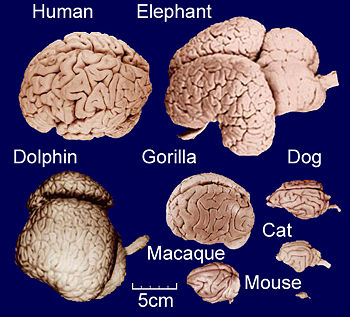
There are thousands of mammals in the animal kingdom that differ in everything from color and appetite to size and habitat. Among body and paw size, brain size also varies among different animals. While a mouse’s brain weighs on average 0.4 grams, an Asian elephant’s brain typically weighs 4,602 grams grams but can that be related to the level of intelligence each animal possesses?
The first figure scientists took into account was the ratio of the brain to the body size, although elephant’s brains weigh around 11 lbs and human’s brains only weigh 2.7 lbs on average, our brains are usually 2% of our body weight compared to under .10% of the elephant’s weight. Elephants need the larger brains to adequately monitor and stabilize their large bodies.
 Paul Manger, professor of health sciences at the University of the Witwatersand, speculated that intelligence does not come from the size of the brain in relation to the size of the body, but rather how the systems inside the brain are organized and operate; how the mind operates and processes information. He found that a dolphin’s brain is comparable to a human’s brain in size, but they are significantly less intelligent than humans. The fatty glial cells in a dolphins brain may add extra volume, but it’s main role is to provide warmth and does not contribute to a dolphin’s intelligence. But what Manger failed to do was define what constitutes as intelligence to him and how he measured that figure. This absence of explanation hurt his research. If it is IQ scores they are testing, how is an animal’s intelligence measured and is that a fair basis for humans, even though some struggle to take a test effectively? Does a standardized test successfully score intelligence a person uses from day to day?
Nacy Barrickman, a graduate student in Duke University’s Department of Biological Anthropology and Anatomy, took interest in the same topic, but found that species that have a relatively large brain in comparison to their body size have more “complex cognitive skills, such as innovative solutions to ecological problems, more efficient resource mapping and food acquisition, and more complex social strategies.” The differences between brain sizes and advanced cognitive skills exist, but are small, however. Since the differences are minimal, scientists have found it difficult to determine whether brain size plays a factor in intelligence or if there are confounding variables that take the responsibility. Possible variables could be the density of neurons or other matters that make-up the brain in each species. The culture they live in and any adaptations over the years may also effect any outcomes and make it difficult for scientists to find the real reason.
 In a separate study, researchers collected and reviewed 21,151 brain scans to notice a correlation between certain genes and brain size. Genetic sequence, “HMGA2 gene on chromosome 12” was found to be related to determining how much one’s brain can grow. The lower the intracranial volume, the lower the IQ scores. A second gene sequence was found to increase memory with the increase in size of the hippocampus, a part of the brain that controls one’s memories. While correlation does not equal causation and this particular study was observational rather than experimental, the results are somewhat assuring that there is a link between brain size and intelligence, but I am still not convinced. This particular study may have suffered from Texas sharp-shooter problem, looking to find any relation the genes may have to brain development. The study does not address any of these problems nor rule out reverse causation.
Since there are multiple studies, some more reliable than others, on the topic each with differing perspectives, it is hard to say whether the size of a brain can be related to intelligence. The first step to solving this theory is for scientists to agree on a single definition of intelligence. The next step would be to perform more studies and rule out any Texas sharp-shooter problems, confounding variables, and reverse causation. Once that is completed, we may have a better understanding on the power of the size of one’s brain.
I mean it when I say this blog was very interesting. The brain-to-body ratio seems plausible to some extent and I’d never considered that before. Also, I like how you were critical of all the research you used, especially with your notice of the Texas sharp-shooter problem in the last study mentioned. If you want to write another blog like this, there are a lot of interesting directions you can take. In the movie “Lucy” they discussed the percentage of the brain used and said that dolphins used more of their brains than humans. I would be very interested to read a follow-up blog on that type of a topic. Another direction to take would be to do some type of ranking blog in which you rank the top species including humans in terms of intelligence. Right now, I have no idea what species comes after humans and that would definitely be interesting to learn. Here is a link for a source centered on the intelligence of ants that could be considered for that blog.
http://www.boris.ryabko.net/nlet.pdf