Author Archives: Sarah Elizabeth Stiffler

Mammograms: when should women start getting them?

Occasionally, my mom will text me about something big going on in the news.  Its a way for her to keep me updated while I’m in my little college bubble, and I love it.  This morning she texted me about mammograms, and how there is a big debate going on right now about what age women should start getting them.  I figured I would look into it, and it would be a good topic for a blog.

What started the recent controversy was a new statement from the American Cancer Society.  They claim that it is now better for women to start yearly mammograms at 45, and then start going every other year at age 55.  Many people are upset about this because they feel that starting before age 45 would be more beneficial because you will be more likely to catch the cancer early.  According to the ACS, though, that isn’t the right plan of action.  They believe, through new studies, that the radiation from mammograms isn’t worth it before the age of 45.

I decided to look into the actual study done by The Journal of the American Medical Association. After doing several blogs, and looking into several studies, I think this is the most well-done study I have seen so far.  For each part of the study, they used at least 100,000 participants.  Even though it was an observational study, I think the results are trustworthy because patients can’t fake breast cancer.  The results show that the risks of having breast cancer and dying from it under the age of 45 are lower than the chances of having breast cancer over the age of 45 and dying from it.

The other issue with mammograms is that there are often many false positives.  People go through the pain of finding out they have breast cancer, only to find out later that they do not actually have it.  Moving the age of mammograms to 45 takes away the risk of having to go through the psychological struggle of thinking you have cancer, when in reality you don’t.  Along with the risk of receiving a false positive, women are unnecessarily exposed to radiation.  Each mammogram exposes each woman to .4 mSV (radiation).  To put that into perceptive, most people are exposed to 3 mSV just from the environment. While that may not seem like a lot, the extra 5 years of mammograms if you start at age 40 adds 2 mSV to your body, which is not good for you at all. Radiation affects almost every part of the body in a negative way.

Across the country, many people are upset about the new guidelines, especially breast cancer survivors.  They believe that early detection is important, but it doesn’t seem like they are taking the radiation factor into consideration.  Overall, after seeing the new research, I think it is smart to wait until 45 to get a mammogram.

Sick Sarah

The Penn State plague has hit me hard.  Over the past month, I’ve had bronchitis, a sinus infection, and a double ear infection.  The first antibiotics the doctor put me on didn’t work, so he prescribed me something stronger.  I am seven days into my new antibiotic, and I am still blowing my nose every few minutes, and the glands on my neck are the size of golf balls. Why am I not getting better?

I wash my hands constantly, but does that really stop the germs? One study from The Atlantic shows that there is only a small difference between washing your hands with water versus water and soap, and soap itself can even be contaminated with germs.  Soap also does not kill viruses as successfully as it kills bacteria because soap molecules have proteins rather than lipids, and proteins cannot dissolve the capsid or membrane of the virus. This could explain why the antibiotics aren’t helping, because they kill bacteria, not viruses, and bacteria is already killed by the soap.  Along with that unfortunate factor, I also have to touch door knobs and other germ-filled areas when I leave the bathroom.

I have an extremely nasty habit: I bite my nails.  After reading the last paragraph, you can see why that is bad for my health.  The viruses get into my body through my mouth from my fingers (that’s so gross, I know!).  It is a terrible habit that needs to be kicked right away if I want to get better, but It is hard to just suddenly stop a habit you have had for over a decade.

Sick-Kitten

Another aspect of my germ-receiving comes from the air.  All of my classes have over 300 students, so the air is gross to say the least. Coughs, sneezes, and any sort of breathing adds germs to the air, and they all circulate around the sometimes hot classroom. One sneeze contains 10,000 bacteria.  If one third of just one of my classes sneezes during a lecture, there will be 1,000,000 bacteria in the room. How do you even avoid that? Hopefully at least some of those people would use a tissue.

I feel bad going to class when I am sick, because I add to those germs, but there are precautions to avoid getting other people sick.  I always wash my hands, use tissues when I sneeze, cough into my elbow, and stay a few feet away from the people around me.  Hopefully the people in my classes and in my dorm will do the same so that I can get rid of this terrible plague!


My phone is making me tired

According to PBS, one in three teens send more than 100 texts a day.  I am definitely one of those teens.  My phone is glued to my hand or pocket all day, and I answer each text within 30 seconds of recieving it. My phone is my life, and without it I would be lost.  One major time I use it is before bed.  At midnight, I’ll lay under my blankets, staring at the tiny lit screen, reading tweets that I might have missed throughout the day.  When I’m finally tired enough, I lock it and turn over to try to fall asleep.  According to recent studies, though, I’m doing exactly what I shouldn’t be doing before bed.

study from 2008, when cell phones were less popular than they are now, showed that cell phone use before bed causes people to not be in a deep sleep as long throughout the night.  “Sleep Texting” is even an increasing issue among teens, which involves replying to a text while you are sleeping (I am also guilty of doing this).  If you are texting in your sleep, you are clearly not actually in a deep sleep, which means you may not be getting the necessary hours needed to function properly the next day.

A study from  Brigham and Women’s Hospital in Boston conducted a well done study of the effects of light on sleep. The study was a randomized control study, but was not double-blind, which could affect the conclusion slightly. Twelve subjects read on an iPad before bed, and twelve read on printed books.  The subjects that read on the iPad had less melatonin, and “experienced shorter restorative REM cycles, delayed circadian rhythms, and felt sleepier the next morning despite getting eight hours of sleep.” Because there was a control group, I feel that the conclusion of this study, that light affects sleep, is an accurate and safe conclusion.

A few days ago, I wrote a blog about my struggles with sleep talking. After doing my research on phone use before bed, I am starting to wonder if my phone use has something to do with my sleep talking. It seems plausible that my cell phone use is causing me to not be in a deep sleep, which then may cause me to sleep talk.  It would be interesting to do an experiment where one group uses their phones before bed and one group doesn’t, and then track their sleep throughout the night.  We could easily see who sleep talks more and if there is a correlation between the two.

My research has opened my eyes to see that I need to be careful with how much I use my phone.  As a college student, any sleep I can get is vital to my success, so jeopardizing that sleep with my phone use hasn’t been a smart move.

Money Buys Happiness

“Money doesn’t buy happiness” is a commonly used statement.  How correct is it, though? Money can buy a lot of things: clothes, vacations, jewelry, movie tickets, college tuition, food. Most of those things cause people to feel some sort of happiness, right? Happiness is defined as “good fortune; pleasure; contentment; joy.” From personal experience, I would say that there are many things I have bought that have caused me to feel some kind of pleasure or joy. I’ve also learned in my Economics class that people spend their money on objects that give them some sort of benefit, or “utility.”

The Wall Street Journal has a long article titled “Can Money Buy Happiness?,” and it looks at all different aspects of consumers.  The author talks about several different studies, but never talks about the validity of the studies and how they were conducted.  The author concludes that money can buy happiness if it doesn’t lead to debt later in life.  While his conclusion seems plausible, I struggle to fully trust him because he never explains he studies he analyzed to make sure there weren’t confounding variables or biases.  He simply assumed that the studies were correct without doing any research into each one.  Although, he did look at several different studies, instead of just one, so overall his conclusion could be accurate.

The next article I looked at was from PBS.  They’re conclusion was that money can buy happiness if the money is spent on experiences rather than physical objects.  I found that this article was more trust worthy because the author actually took the time to explain the study.  The study was a survey, so because it was not a double-blind randomized control trial, there could be other variables causing the findings. Along with it being a survey, there were only 632 respondents, so that may not be a large enough sample to make a conclusion on.  The study found a correlation between higher income and joy from giving money to charity.  Correlation does not mean causation, but if you think about both PBS and Wall Street Journal, there seems to be a common theme that money can buy happiness.

Overall, I haven’t been able to find a study accurate enough to make a solid conclusion about money and happiness, but it does seem like there could be a correlation between the two.  People who use money to buy experiences seem to be more likely to be happier than people who use money to by objects.


Sleep Talk Central

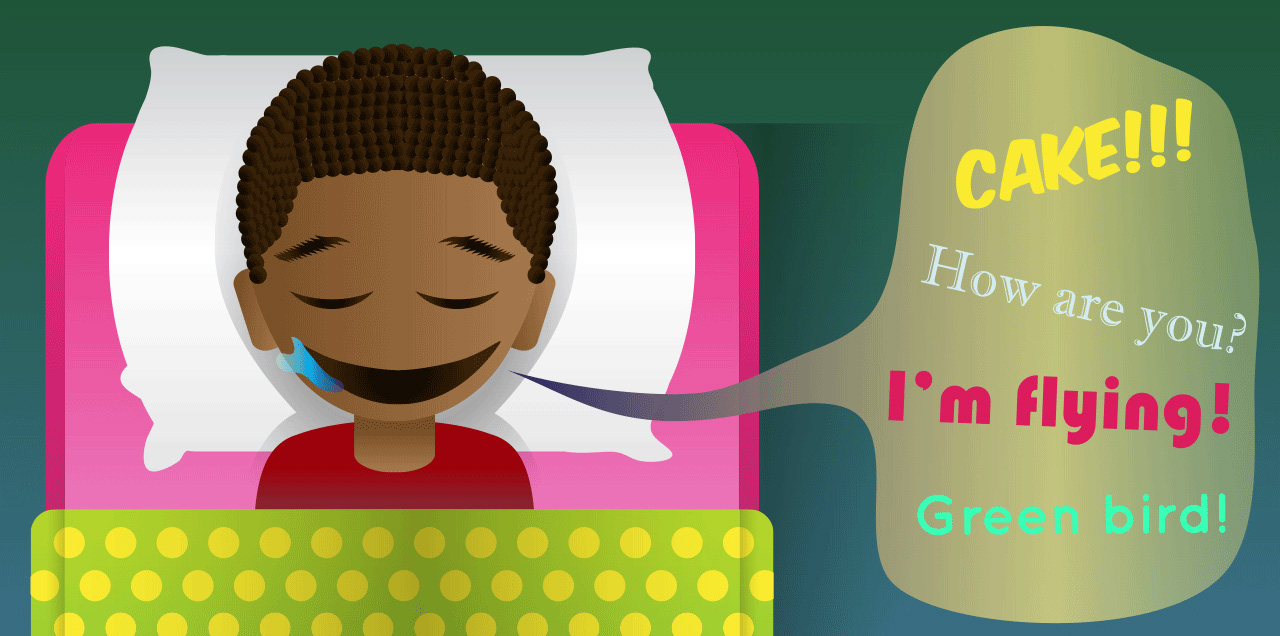
Ever since I have been able to talk, I have talked in my sleep.  Almost every night I mumble something, sometimes even waking myself up.  Now that I have a roommate, my sleep talking has started to be a problem.  Almost every night I wake her up with the sound of me trying to start a conversation or mumbling pointless words that I usually won’t remember in the morning.  College kids need their sleep, so I feel like it is my responsibility to figure out how to stop sleep talking in order to allow my poor roommate to be able to function in the morning.

main

To be able to figure out a remedy, I first need to figure out the actual science behind sleep talking.  There are five stages of sleep: 1, 2, 3, 4, and REM.  Each cycle is a lighter sleep than the next, REM being the deepest sleep out of the five.  Sleep talking usually occurs during the second stage and REM stages of sleep. It is easier to get someone to stop talking during the REM stage than the second stage, which is surprising to me because the REM stage is a deeper sleep.

According to U.S. News, causes of sleep talking could be a serious sleep disorder, or simply stress, depression, or alcohol use.  For me, the cause of my sleep talking is most likely stress.  I also found it interesting to see that sleep talking may run in families.  My mother, aunt, and cousin all do it, and we have had full conversations with each other in our sleep.

So how can I stop it? Some sources recommend seeing a doctor, especially if your sleep talking involves screaming or violent actions.  Luckily, mine does not. Because mine is not as severe, sources say just to try to lower stress and watch how much caffeine your are consuming throughout the day.  I feel like more studies need to be done about sleep talking, because there doesn’t seem to be a solid conclusion to explain why this happens to me so often.

Mean Girls or Mean Boys?

Being a teenage girl, I have witnessed many instances where girls have been unnecessarily mean to each other.  I, myself, am guilty of it as well.  From saying a girl looks fat in that outfit to questioning why a guy likes that girl, the mean thoughts and comments are endless. Girls constantly feel the need to compete with the girls around them, and are constantly feeling jealous and mad about what they don’t have.

There are two types of aggression.  Relational aggression happens with regards to emotional and social standings, and damages people’s relationships.  Another name for this type of aggression is covert aggression. The other type of aggression is the more conventional form of aggression: physical aggression. This can be actual violence or bullying, which is thought of happening more with boys than girls.

My person experience, although, may be different than what science has found.  A new study reported by Time Magazine shows that boys may actually be meaner than girls. Pamela Orpins, a professor at UGA, randomly sampled 620 students from six different Georgia school districts.  She had the students take a survey, asking them about physical and relational aggression. She found that boys were more likely to be perpetrators of both types of aggression.  While the study seems credible, 620 students is not enough to make a conclusion about the whole population, and it is hard to trust students to be completely honest in a survey.

Another study, at the University of Arizona, led by Noel Card, may prove something different and be more credible.  Card took a sample of 73,500 minors over 148 different studies, and found that there is only a trivial difference between aggression of boys and aggression of girls, and when Card simply looked at psychological studies, there was no difference.  So, his conclusion came to be that gender did not matter. HIs study is more accurate because the sample is a lot larger than the study from the University of Georgia.

Through my findings, I think that it seems like there is no difference between aggression in boys and girls.  The University of Georgia study may have solid evidence, but 620 students is not a large enough sample size to make an accurate conclusion.  The University of Arizona study, on the other hand, seems accurate because of the large sample size and number of studies.  There seems to be no difference between aggression of girls and boys.


Why college students love Tinder

Before college, I would have never ever thought to download Tinder.  I can meet people in person, right? Isn’t Tinder just for random hook ups? When I got to college, though, everyone around me seemed to be using this strange app.  So, one day out of boredom my two friends and I downloaded it and ended up spending two hours of our Tuesday night swiping right for cute boys and left for the awkward boys, giggling when someone messaged us a cheesy pick up line.

According to Tech Crunch, the reason so many people use Tinder is because its a good ice breaker, and doesn’t force people to make an effort to “put themselves out there.” Business Insider even wrote an article about how to improve your profile to get more matches.  Tinder is all about the pictures, so they claim that the best way to get more matches is to strategically choose your pictures. “If you’re standing ‘energetically’ in a photo, for example, meaning you’re not slouching and your feet are pointed towards the camera, viewers are more likely to pick up on your outgoing personality.”  Its like checking someone out in real life, but in this case its on a six inch phone screen. Your Life claims that one billion swipes are made a day, and 12 million matches are made.

The creator of Tinder, Justin Mateen, essentially just took advantage of how lazy college students are. Instead of leaving their dorm rooms and going out into the real world to meet people, they can lay in their comfy yet small bed and within 2 seconds be scanning the app for potential new “friends.”

What college students still need to be aware of is the dangers of online dating.  People can easily pretend to be someone they aren’t, and take advantage of you not knowing who they are.  Here are five safety tips for online dating, should you chose to take part in it.

Overall, the creators of Tinder analyzed the market well when they started to create their app.  They took advantage of college students wanting to meet people without much effort, and through that made a lot of money. You can make yourself look however you want on Tinder, so choose your pictures wisely.

Beer is good for you?

“Just stay away from beer this year and you’ll be okay” my mom said many times before she dropped me off at school. As most people know, beer is high in carbohydrates and calories.  But are there health benefits along with that?

Everyday Health claims that there are eight ways beer is good for you.  Help with inflammation, aid in digestion, cancer prevention, and creating bone strength are just a few of the ways beer is beneficial to your health. There are even institutes for beer research.  One study even says that drinking beer causes the good cholesterol to raise. Organic Facts says that it will decrease the odds of suffering from Type 2 diabetes.  These are just some of the many benefits that have come up through beer research.

But is it worth the calories?  Beer can range anywhere from 70-200 calories a can. So, if someone were to have three beers, their calorie intake could be up to half of the recommended calories for the whole day.  Carbs can also reach from 6-24 grams per can. That, again, could be half of your daily carbohydrates.  If one were to drink like that every weekend, they would without a doubt gain a substantial amount of weight.

So, after my research, I have come to the conclusion that beer is good in moderation.  With all of the health benefits, you would not be smart to not drink it.  But, you must look at the amount of calories and maybe try to stick to the light beers. Watch out for a beer belly!

Are we capable of monogamy?

With divorce rates hitting a new high, and the amount of cheating I’ve seen happen in friends relationships, I’ve started to wonder if men are capable of sticking to just one person for life.  Is it just natural that they cannot commit? I know there are many relationships that work out, like my parents’, but I’m still curious what goes on inside the our brains.

An article by Daily Mail claims that men and women aren’t capable of monogamy. The article claims that neither gender is mentally wired to have one partner for life.  We evolved from chimps and bonobos, which weren’t monogamous either.  Marriage goes back to ancient times, originating in the bible. But just because its from the bible, does it means its right?

The divorce rate in America is 41%.  With the statistic being at almost half of marriages, I’ve started to think that humans really aren’t fit for monogamy.  An article in the New York Times adds another factor in to the argument.  They claim that its about where you live and what surrounds you. Some people need to be monogamous in order to live and support one another. Other cultures are polygamous, and that works out just fine. Only 3 to 5 percent of mammals are known to be monogamous.  So are Americans doing it wrong?

Overall, after doing research, I believe that monogamy is not reasonable.  Our minds are not genetically programmed for monogamy, so I don’t believe we should go against how science created us.  Marriage is okay, but it isn’t natural and is only used to have a support system.

Why is your taste in music so bad?

“Wow, your taste in music is terrible” is a sentence I’ve heard many times in the past 10 years.  When I say many times, I don’t mean it is always said towards me. I’ve heard it being said to all types of music listeners, and I myself have said it too.  Why is this person blasting Scream-o so loudly that I can hear it through the headphones that are in THEIR ears? Well, like everything in life, there seems to be a science behind it.

An article by Elite Daily makes an effort to answer my question.  They say that in your early life, around the age of 12-14, you just like the songs that are popular.   But why do you continue to like songs that are popular? It seems to be because every popular song has around the same formula, so it sounds familiar to you.  So, that new Taylor Swift song is a lot like that old Maroon 5 song, whether you want to believe it or not.

Along with the early life formation of music taste, Adrian C. North adds the issue of personality.  He claims that each music taste is linked to a different personality. Mic.com, a music website, has a whole article about personality versus music taste. Although, Medical Daily seems to disagree with that conclusion. While there might be a small link between the two, they believe that people lie about their music taste to sound more sophisticated.

Health Day claims that each genre of music can be matched with a certain rhythm, so in reality, each person likes a different form of rhythm. Is that rhythm linked to personality? After my research I feel that rhythm is linked to personality which links to music taste. Overall, no music taste is bad music taste, it’s all about how your brain processes it and how it links to your emotional side.

Why do I always have headaches?

Throughout the past six years of my life, I have struggled with concussions from soccer.  After suffering a third concussion during my sophomore year, my parents decided it was time for me to call it quits with any contact sport, causing me to have to quit both soccer and lacrosse.  Ever since my first concussion, I have wondered why I have been more susceptible to concussions than my teammates.

study for The Journal of Primary Prevention found information that had my mom convinced that the cause of my concussions was my lack of neck strength.  While the study does show that smaller neck circumference is usually directly proportional to neck strength, I wasn’t exactly convinced.  Maybe that had to do with getting my first concussion, but what about my second and third?  And why did I get them all in a matter of three years?

An NPR interview with concussion specialist from NYU Steven Flanagan talks about how just one concussion can cause long lasting effects.  It has been six years since my first concussion and three years since my last concussion. To this day, I still suffer from frequent headaches and trouble remembering both long term and short term.  Another issue Dr. Flanagan brings up is how hard it is to diagnose a concussion.  Because it is not always easy, people mistake concussions for less serious injuries or for not being injuries at all. These are the ways to diagnose concussions, and they are all very broad and not always trustworthy.  If concussions aren’t diagnosed right away, the concussion can be even more detrimental to the brain.

So after all this research, what is the answer to my question? I understand why I got the concussion, but why do I have so many headaches 3 years later? According to Doctor Seymour Solomon, headaches after concussions are called “post-traumatic” headaches,  and can last anywhere from months to years after a initial injury.  According to Dr. Solomon, the nerves are disrupted from the trauma, which is most likely why I still have these headaches.

Hopefully someday someone will come up with a treatment for my longterm side effects, but for now I’ll just have to continue to push through them myself.  I wish that I would’ve taken the time to strengthen my neck, but I still think I would’ve suffered from the concussions anyway.

concussion-illus-350x283

First Blog Post

My name is Sarah Stiffler and I am a freshman from Pittsburgh, Pennsylvania. I love Penn State so much so far and I can’t believe I ever considered Ohio State. I plan on attending every football game this year and can’t wait to rush this week. I am planning on majoring in Finance if I can get the required 3.5 GPA. I am not majoring in science because I want to be a lawyer or a CFO some day and I feel that a business degree will get me farther with that than a science degree will. I still enjoy science and this class seemed extremely interesting to me. I like that it has to do with current events and the topics for each class are very intriguing! Below is a picture of the lovely city of Pittsburgh at night, and here is a link to my soundcloud (I don’t make music I just repost songs that I love!)

Pittsburgh_WEO_Night_1